admin
admin
The tokenization of real-world assets (RWAs) is rapidly emerging as a transformative trend within the global financial sector, leveraging blockchain technology to represent traditional assets such as real estate, commodities, private equity, and debt on a distributed ledger. This innovation promises to unlock unprecedented liquidity, enhance transparency, and streamline operational efficiencies across various asset classes. At the forefront of enabling this paradigm shift is Chainlink, whose comprehensive suite of decentralized oracle services is proving indispensable for securely and efficiently bridging the divide between off-chain assets and on-chain protocols.
The Evolution and Economic Imperative of RWA Tokenization
Real-world assets encompass a vast spectrum of tangible and intangible holdings, from physical property and precious metals to intellectual property, art, and complex financial instruments like bonds and derivatives. Historically, these assets have been characterized by illiquidity, high transaction costs, limited fractional ownership opportunities, and opaque settlement processes. The concept of tokenization, while not entirely new—stablecoins, for instance, are early examples of tokenized fiat currency—has gained significant traction due to the maturation of blockchain technology, growing institutional interest, and an evolving regulatory landscape.
The economic imperative for RWA tokenization is compelling. Traditional markets often suffer from inefficiencies rooted in manual processes, reliance on numerous intermediaries, and geographical barriers. Tokenization addresses these issues by creating digital representations of assets on a blockchain, complete with immutable records of ownership and transaction history. This not only digitizes ownership but also enables programmable features, allowing for automated compliance, instant settlement, and novel financial structures.
Projections from leading financial institutions and consulting firms underscore the monumental potential of this market. Boston Consulting Group, in collaboration with Figure Technologies, estimated that the tokenization of illiquid assets alone could reach $16 trillion by 2030. Similarly, BlackRock CEO Larry Fink has frequently highlighted the immense potential of tokenization to revolutionize capital markets, citing its ability to enhance efficiency and reduce costs. Citi, in a comprehensive report, projected that blockchain-based tokenization could be the "killer app" that brings trillions of dollars of traditional finance onto distributed ledger technology. These figures signify not just a technological upgrade but a fundamental restructuring of how assets are owned, traded, and managed globally.
Key Benefits Driving Adoption:
- Enhanced Liquidity: By converting traditionally illiquid assets into divisible and tradable digital tokens, tokenization opens them up to a broader market, making them easier to buy and sell.
- Fractional Ownership: High-value assets like real estate or fine art, once accessible only to a select few, can now be divided into smaller, affordable tokens, democratizing investment opportunities.
- Increased Transparency: All ownership and transaction records are immutably stored on the blockchain, providing an auditable and tamper-proof history, reducing fraud and increasing trust.
- Operational Efficiency: Automated smart contracts can handle various aspects of asset management, from dividend distribution to governance, reducing the need for intermediaries and lowering operational costs.
- Global Accessibility: Blockchain-based assets can be traded across borders 24/7, fostering a truly global and continuous market.
Chainlink’s Foundational Role: Bridging the On-Chain and Off-Chain Divide
While blockchain offers a robust infrastructure for digital assets, smart contracts, by their nature, are isolated from the external world. They cannot inherently access real-world data or interact with off-chain systems. This limitation, known as the "oracle problem," is precisely where Chainlink’s decentralized oracle networks become indispensable. Chainlink acts as a secure middleware, providing smart contracts with reliable, tamper-proof access to external data and off-chain computation, which is critical for RWA tokenization.
Chainlink’s established reputation as the industry-standard oracle network, with extensive integrations across various blockchain ecosystems and a proven track record of securing billions of dollars in value, positions it uniquely to facilitate institutional adoption of RWA tokenization. Chainlink leadership consistently emphasizes that the secure and reliable flow of data, coupled with robust interoperability, are non-negotiable requirements for traditional financial institutions to confidently engage with blockchain technology. Without such robust infrastructure, the promise of RWA tokenization would remain largely theoretical, confined by the inherent limitations of isolated on-chain environments.
Chainlink Services Powering RWA Tokenization
Chainlink offers a comprehensive suite of services specifically designed to address the complex requirements of RWA tokenization:
-
Chainlink Data Feeds:
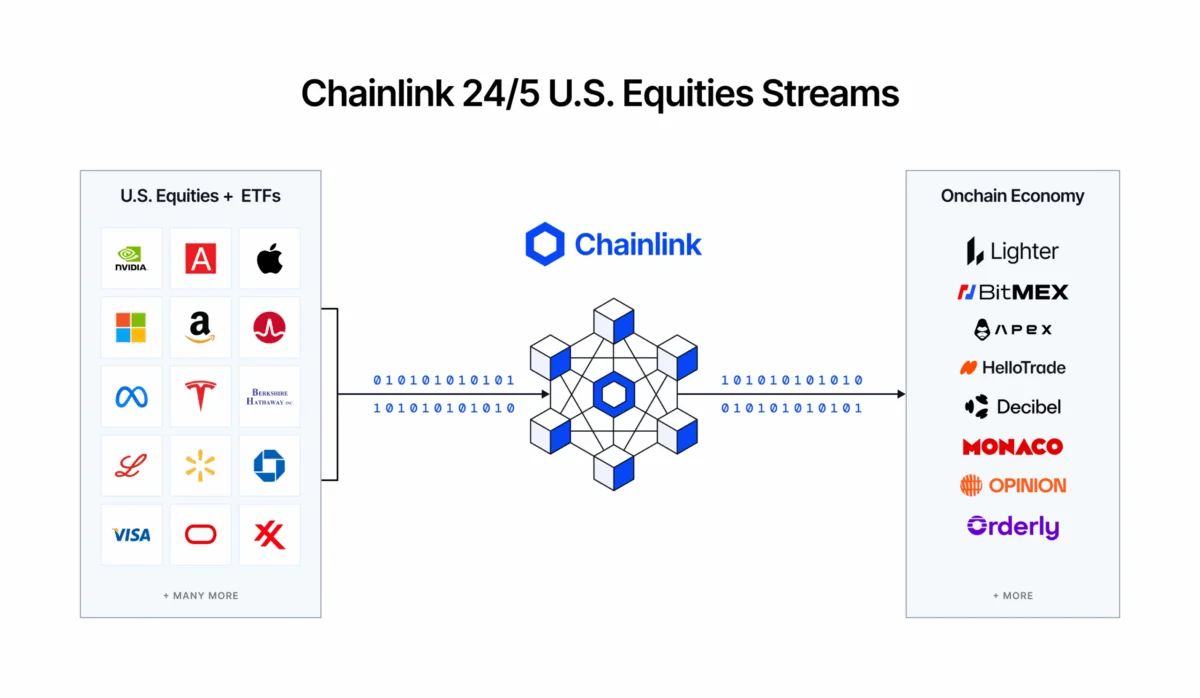
- Functionality: Chainlink Data Feeds provide smart contracts with real-time, tamper-proof market data from a multitude of high-quality off-chain sources. These feeds are secured by decentralized networks of independent oracle nodes, which aggregate data to ensure accuracy and resistance to manipulation.
- RWA Application: For tokenized assets, accurate valuation is paramount. Data Feeds can provide up-to-the-minute price information for commodities (e.g., gold, oil), real estate valuations based on market indices, or FX rates crucial for cross-border token transactions. For example, a tokenized real estate platform might use a Chainlink Data Feed to periodically update the market value of properties represented by its tokens, ensuring that investors have access to current and reliable pricing. Similarly, a tokenized bond might rely on interest rate data feeds for coupon payments.
-
Chainlink Proof of Reserve (PoR):
- Functionality: Proof of Reserve automates the verification of off-chain collateral held to back on-chain assets. Decentralized oracle networks continuously monitor the reserves held in traditional financial institutions or other custodians, ensuring that the tokenized asset is fully collateralized.
- RWA Application: This service is critical for building trust and ensuring the solvency of tokenized assets. For stablecoins, PoR verifies the fiat currency reserves. For tokenized commodities like gold or silver, it confirms the physical holdings. For tokenized debt instruments, it can verify the underlying treasury bonds or other collateral. This transparency is vital for investor confidence and meeting regulatory requirements for asset-backed tokens.
-
Chainlink Cross-Chain Interoperability Protocol (CCIP):
- Functionality: CCIP provides a secure and reliable way for arbitrary data and tokens to be transferred between different blockchain networks. It is designed to be the industry standard for cross-chain communication, offering robust security features, including a Risk Management Network that independently monitors all cross-chain transactions.
- RWA Application: In a multi-chain future, RWA tokenization will likely span various public and private blockchains. CCIP enables seamless movement of tokenized assets between these networks. For instance, a tokenized private equity fund initially issued on a permissioned blockchain could be transferred to a public blockchain for secondary trading, expanding its market reach. CCIP also facilitates complex cross-chain payment flows or the transfer of ownership records across different ledgers without compromising security.
-
Chainlink Automated Compliance Engine (ACE):
- Functionality: ACE automates complex regulatory compliance checks directly on-chain. It allows smart contracts to verify identity (KYC/AML), sanctions screening, investor accreditation status, and other jurisdictional requirements based on predefined rules and verified off-chain data.
- RWA Application: Regulatory adherence is a major hurdle for institutional adoption of tokenized assets. ACE enables platforms to programmatically enforce compliance. For example, a platform issuing tokenized securities could use ACE to automatically restrict trading to accredited investors in specific jurisdictions, or to prevent transactions with sanctioned entities, significantly reducing the manual burden and potential for errors in compliance.
-
Chainlink Confidential Compute:
- Functionality: Confidential compute solutions, such as those leveraging Trusted Execution Environments (TEEs) or zero-knowledge proofs, allow sensitive data to be processed privately off-chain while still enabling its verification and use by smart contracts. This addresses privacy concerns inherent in public blockchain environments.
- RWA Application: Many RWAs involve sensitive or proprietary information that cannot be exposed on a public ledger. Confidential compute enables scenarios like private credit scoring for tokenized loans, processing confidential financial statements for tokenized private equity, or protecting proprietary trading strategies. This ensures that privacy is maintained while leveraging the benefits of blockchain for verification and settlement.
-
Chainlink Runtime Environment (CRE) & SmartData:
- Functionality: The Chainlink Runtime Environment (CRE) offers a flexible and secure environment for developing and deploying advanced off-chain computations. SmartData complements this by allowing the creation of rich, context-aware data feeds, combining various data points for sophisticated RWA use cases.
- RWA Application: For complex RWAs, pricing models, risk analytics, and dynamic asset management often require extensive off-chain computation. CRE can execute these computations securely and feed the results back on-chain. SmartData can aggregate diverse data points—such as environmental data for tokenized carbon credits, usage data for royalty-bearing tokens, or market sentiment for unique collectibles—to create highly granular and responsive tokenized assets. This enables more sophisticated financial products and risk management strategies in the tokenized economy.
Implications and Future Outlook
Chainlink’s robust infrastructure addresses many of the critical challenges hindering the mainstream adoption of RWA tokenization, particularly for institutional players. By providing verifiable data, secure interoperability, automated compliance, and privacy-preserving computation, Chainlink significantly lowers the barriers to entry for traditional finance into the blockchain space.
The broader implications are profound:
- Institutional Transformation: Financial institutions can leverage tokenization to create new revenue streams, reduce operational costs, and offer more innovative products to their clients. This includes tokenized funds, bonds, real estate portfolios, and even private market assets.
- Democratization of Investment: Fractional ownership and increased liquidity can open up high-value investment opportunities to a much broader global investor base, fostering financial inclusion.
- New Market Structures: Tokenization can facilitate the creation of entirely new types of markets and financial instruments, such as tokenized derivatives on illiquid assets or highly customized debt instruments.
- Regulatory Alignment: As regulatory frameworks continue to evolve, Chainlink’s tools like ACE provide a critical pathway for tokenized assets to meet compliance standards in an automated and verifiable manner, accelerating regulatory clarity and adoption.
While challenges remain, including further regulatory harmonization and continued education for market participants, Chainlink is unequivocally positioned as a pivotal driver in realizing the full potential of real-world asset tokenization. By securely connecting the vast and complex world of traditional assets to the efficiency and innovation of blockchain, Chainlink is not just enabling a new financial product category but is laying the groundwork for a more efficient, transparent, and accessible global financial system. Its continuous innovation and commitment to security make it an indispensable partner in the ongoing evolution of finance.