admin
admin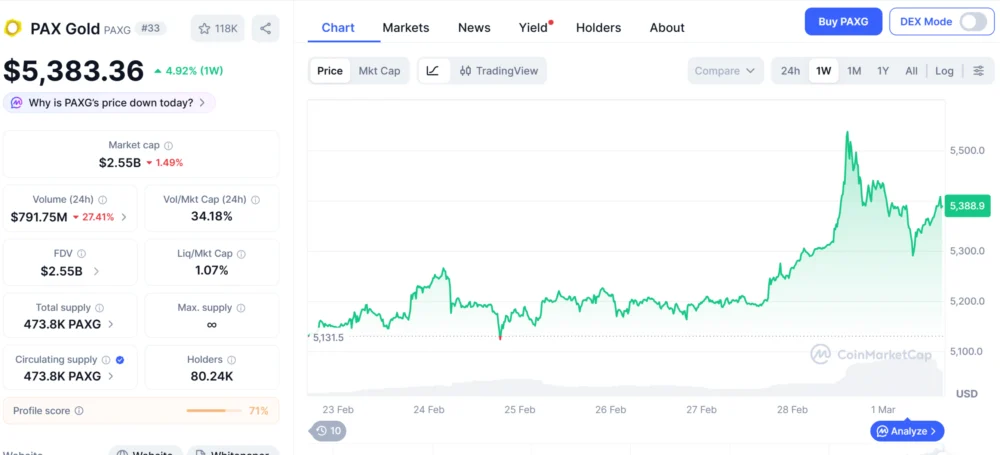
Gold pricing increasingly shifts its primary mechanism for discovery onto blockchain networks once traditional U.S. futures markets conclude trading for the weekend. This significant development highlights the growing influence of digital assets in the broader financial landscape, according to Iggy Ioppe, former Chief Investment Officer (CIO) at Credit Suisse and current CIO at liquidity infrastructure firm Theo. The transition underscores a critical evolution in how the value of one of the world’s oldest safe-haven assets is determined during periods of conventional market dormancy.
The Chicago Mercantile Exchange (CME) gold futures, a global benchmark for gold pricing, halt trading at 5:00 PM ET on Friday and do not resume until 6:00 PM ET on Sunday. This roughly 49-hour interval creates a unique void in regulated, publicly reported gold trading. Historically, during this period, most remaining activity in the gold market has occurred through private, over-the-counter (OTC) deals predominantly in Asian markets. These transactions, while crucial for liquidity, are typically opaque, decentralized, and not publicly reported, making true price discovery challenging and non-transparent for the wider market.
The Weekend Shift: Blockchain Emerges as Gold’s Price Anchor
It is within this weekend trading vacuum that tokenized gold assets have emerged as the dominant force for price formation. Products like PAX Gold (PAXG) and Tether Gold (XAUt), which are digital representations of physical gold held in secure vaults, offer continuous, 24/7 trading on various blockchain-based platforms. This always-on nature positions them as the only continuously available and publicly visible trading venues for gold during the weekend closure of traditional futures markets.
"In terms of publicly visible price formation, onchain markets are responsible for virtually 100% of weekend price discovery," Ioppe explained to Cointelegraph, emphasizing the transformative role these digital assets now play. He further elaborated that the price movements observed on these blockchain networks during the weekend often serve as a reliable indicator for the subsequent opening of traditional markets. "We are seeing weekend moves reflected when CME reopens," Ioppe noted, suggesting that traditional futures prices frequently align with the trends established by tokenized gold, thereby confirming the digital market’s newfound influence. This phenomenon offers a compelling illustration of blockchain’s capacity to enhance market transparency and efficiency, bridging gaps left by conventional financial structures.
The Explosive Growth of Tokenized Gold Assets
This shift in price discovery is not an isolated event but rather a symptom of the meteoric rise of the tokenized gold sector. Over the past year, tokenized gold has experienced an unprecedented expansion, solidifying its position as a burgeoning force within the broader real-world asset (RWA) tokenization movement. The market capitalization of tokenized gold soared from approximately $1.6 billion to an impressive $4.4 billion, adding nearly $2.8 billion in value during this period. This represents a staggering 177% increase, a growth rate that has significantly outpaced both the broader physical gold market and most major spot gold Exchange Traded Funds (ETFs).
The expansion wasn’t limited to market value; the number of holders of these digital gold assets nearly tripled, with over 115,000 new wallets acquiring tokenized gold. This surge in participation indicates a broadening base of investors, from crypto-native individuals seeking stable store-of-value assets to institutional entities exploring new avenues for gold exposure. The growth trajectory of tokenized gold contributed roughly a quarter of all net inflows into the burgeoning RWA sector, a testament to its leading role in the tokenization of tangible assets. Furthermore, its expansion exceeded the combined growth of other tokenized categories, including tokenized stocks, corporate bonds, and non-U.S. Treasuries, highlighting its distinct appeal and market traction.
Accompanying this market cap surge, trading activity in tokenized gold also experienced a dramatic increase. In 2025, the sector recorded approximately $178 billion in trading volume, with a peak above $126 billion observed in the fourth quarter alone. To put this in perspective, such a volume level would position tokenized gold as the second-largest gold investment product globally by trading volume, surpassed only by the SPDR Gold Shares (GLD), the world’s largest physically backed gold ETF. This comparison underscores the increasing liquidity and institutional relevance of tokenized gold, moving it beyond a niche crypto offering to a serious contender in the global gold market.

Key Players and Strategies Driving Adoption
The burgeoning tokenized gold market is driven by a diverse array of participants employing sophisticated strategies. Iggy Ioppe pointed out that market makers and cross-venue liquidity providers constitute a dominant force, actively engaging in arbitrage to capitalize on price differences between digital and traditional gold markets. These entities play a crucial role in ensuring price consistency and efficient capital allocation across disparate trading environments.
Beyond traditional arbitrageurs, crypto-native macro traders have also emerged as significant players. These sophisticated investors leverage tokenized gold not merely for direct exposure to bullion prices but also for a range of advanced financial strategies. This includes using tokenized gold as collateral in decentralized finance (DeFi) protocols, for hedging against broader market volatility, and for yield-generating strategies, particularly during periods marked by heightened geopolitical or macroeconomic uncertainty. The inherent stability of gold, combined with the flexibility and composability offered by its tokenized form, makes it an attractive asset for managing risk and optimizing returns within the crypto ecosystem.
Ioppe further noted that traditional financial institutions are increasingly monitoring these weekend on-chain gold markets. "Some institutions are monitoring weekend onchain gold markets, particularly macro and cross-asset desks that track gap risk ahead of the CME reopen," he stated. While most institutions currently treat this signal as informational, rather than a basis for active positioning, their attention signifies a growing acknowledgment of tokenized gold’s predictive power and its role in gauging market sentiment outside of conventional trading hours. This "gap risk" refers to the potential for a significant price difference between a market’s closing price and its opening price, often triggered by off-hours news or events.
24/7 Trading: A New Paradigm for Risk Management
The continuous trading nature of tokenized gold markets offers a practical and significant advantage in risk management. In traditional financial markets, if a major geopolitical event or economic shock occurs while futures markets are closed, participants are unable to adjust their positions, leaving them exposed to potential losses or missed opportunities. Tokenized markets, by operating 24/7, enable immediate rebalancing of portfolios and real-time responses to global events.
This advantage was starkly illustrated recently. On a particular Saturday, tokenized gold rallied sharply as geopolitical tensions escalated following reports of US and Israeli strikes on Iran. As news of the events unfolded during a period when traditional markets were shuttered, investors sought refuge in tokenized gold assets such. While Bitcoin (BTC) and Ether (ETH) experienced declines, XAUT briefly climbed above $5,450, and PAXG neared $5,536 during the day before paring some gains, according to data from CoinMarketCap. This immediate flight to safety into tokenized gold, while other crypto assets fell, showcased its real-time utility as a safe-haven asset in a volatile global environment, demonstrating its ability to provide instantaneous liquidity and risk mitigation when traditional avenues are unavailable.
Challenges to Widespread Institutional Adoption
Despite its impressive growth and demonstrated utility, tokenized gold’s path to widespread institutional adoption is not without obstacles. Ioppe highlighted several key challenges that need to be addressed for the sector to fully integrate with mainstream finance.
One primary concern is liquidity. While trading volumes have surged, the overall liquidity in tokenized gold markets remains smaller compared to the vast depth of traditional futures markets or established gold ETFs. This can make it challenging for very large institutional trades to be executed without significantly impacting prices, a phenomenon known as slippage. For institutions accustomed to executing massive orders with minimal market disturbance, this remains a crucial hurdle.

Regulatory clarity also presents a significant challenge. While the regulatory landscape is gradually improving, it remains highly fragmented across different jurisdictions. "Regulatory clarity is improving, but fragmentation across jurisdictions slows institutional deployment," Ioppe stated. This patchwork of rules and varying legal interpretations creates uncertainty for global financial institutions that operate across multiple regions, hindering their ability to deploy capital at scale into tokenized assets. Issues related to custody, accounting standards, and capital rules still vary widely, requiring a more harmonized and globally recognized framework to foster greater institutional confidence and participation.
Tokenized Gold: A Catalyst for Real-World Asset (RWA) Tokenization
The success and evolving role of tokenized gold serve as a powerful proof of concept for the broader real-world asset (RWA) tokenization movement. As a leading example, it demonstrates the potential for blockchain technology to bring illiquid or traditionally cumbersome assets onto a transparent, programmable, and 24/7 accessible ledger.
The principles proven by tokenized gold – fractional ownership, enhanced liquidity, reduced settlement times, and immutable record-keeping – can be applied to a vast array of other assets, including real estate, commodities, fine art, and even intellectual property. The ability to manage risk continuously, as seen with tokenized gold during weekend geopolitical events, sets a new standard for asset management and provides a blueprint for how other RWAs can benefit from blockchain integration. This pioneering role positions tokenized gold not just as a digital alternative to physical bullion, but as a catalyst for a paradigm shift in how all assets are owned, traded, and managed globally.
The Future Landscape: Parallel Evolution, Not Replacement
Looking ahead, Ioppe anticipates a future where tokenized and traditional gold markets coexist, rather than one fully replacing the other. "The most likely near-term evolution is that of tokenized and traditional markets existing in parallel, each serving a different function," he concluded. This perspective suggests a symbiotic relationship, where tokenized gold continues to fill crucial gaps in market access, transparency, and continuous trading, particularly during off-hours, while traditional markets maintain their role as established, deeply liquid venues for large-scale institutional participation during regular trading hours.
This parallel evolution implies that tokenized gold will likely continue to innovate, potentially integrating more deeply with decentralized finance (DeFi) protocols and attracting a new generation of investors and institutions comfortable with digital assets. Simultaneously, traditional markets may adopt certain efficiencies or insights derived from their digital counterparts, leading to an overall more robust and interconnected global gold market. The ultimate outcome will be a more resilient, accessible, and transparent gold ecosystem, better equipped to serve the diverse needs of investors worldwide.
The ongoing transformation of gold price discovery during weekends represents a critical milestone in the convergence of traditional finance and blockchain technology. As tokenized gold continues its rapid ascent, its influence is poised to reshape not only the gold market itself but also the broader landscape of real-world asset tokenization, paving the way for a more integrated and continuously operating global financial system.