admin
admin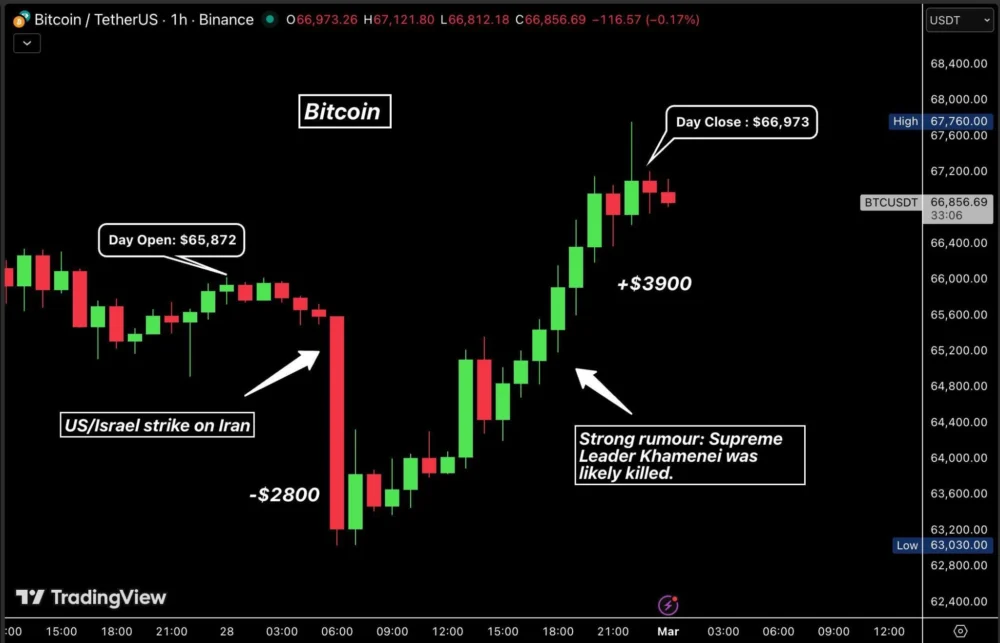
Bitcoin (BTC) prices have demonstrated a robust recovery, reversing a sharp dip triggered by reports of US-Israeli air strikes on Iran and the subsequent news concerning the alleged death of Iranian Supreme Leader Ayatollah Ali Khamenei. The premier cryptocurrency, often scrutinized for its sensitivity to global geopolitical tremors, saw its value rebound dramatically, recouping substantial losses and returning to pre-conflict levels within a mere 24-hour window. This swift market correction underscores the intricate interplay between global political stability, investor sentiment, and the volatile dynamics of the cryptocurrency landscape.
Geopolitical Instability and Initial Market Reaction
The initial downturn in Bitcoin’s value was directly linked to a sudden escalation of tensions in the Middle East. Reports emerged on Saturday detailing a series of US-Israeli air strikes targeting locations within Iran. This development immediately injected a significant degree of uncertainty into global financial markets, prompting a typical flight-to-safety response. Historically, periods of heightened geopolitical risk often see investors shift assets away from perceived riskier holdings, such as cryptocurrencies, towards traditional safe havens like gold or government bonds. Bitcoin, despite its proponents often touting its "digital gold" characteristics, frequently exhibits characteristics of a risk-on asset, particularly during acute, unexpected global events.
In the immediate aftermath of the airstrike reports, Bitcoin prices experienced a rapid decline, plummeting from approximately $68,000 to as low as $63,000. This represented a significant loss of nearly $5,000, or over 7%, in a short span, reflecting the market’s knee-jerk reaction to the perceived increase in regional instability. The Middle East has long been a focal point of geopolitical contention, with the relationship between the United States, Israel, and Iran being particularly fraught. Any military action involving these key players carries the potential for widespread destabilization, impacting global oil prices, diplomatic relations, and, consequently, investor confidence across various asset classes, including digital currencies.
The Catalyst for Recovery: Reports of Khamenei’s Demise
The dramatic turnaround in Bitcoin’s fortunes began to materialize following unconfirmed but widely circulated reports concerning the death of Iran’s Supreme Leader, Ayatollah Ali Khamenei. The BBC, citing Iran’s Supreme National Security Council, reported on Saturday that Ayatollah Khamenei had been killed at his office. This news, if confirmed, would represent a monumental shift in Iranian leadership and potentially in the broader geopolitical calculus of the region.
Markets often react intensely to news of significant political transitions, particularly when they involve long-standing, influential figures in autocratic states. For Bitcoin and other risk assets, the perceived implication of Khamenei’s death, especially in the context of ongoing US-Iran tensions, was interpreted by some as a potential pathway towards de-escalation or a resolution to the conflict. Analyst Ash Crypto commented on Sunday, "After news of Iran’s Supreme Leader Khamenei’s death, the market pumped because people are taking it as the end of the US-Iran war." This sentiment, whether ultimately accurate or not, served as a powerful catalyst, signaling to investors that the immediate threat of further escalation might be receding, thus encouraging a return to risk-on assets.
Following these reports, Bitcoin prices surged, reaching $68,200 in early trading on Sunday morning on Coinbase, according to data from TradingView. This remarkable ascent meant the asset had recovered all losses incurred during the preceding dip, adding approximately $5,000 to its value in less than 24 hours. At the time of writing, BTC was trading around $67,350, effectively returning to its Friday levels and demonstrating a profound resilience in the face of significant external shocks.
Timeline of Events and Key Figures
The sequence of events unfolded rapidly over the weekend:
- Saturday (Early): Reports emerge of US-Israeli air strikes targeting Iran, leading to immediate market uncertainty and a sharp decline in Bitcoin’s price from approximately $68,000 to $63,000.
- Saturday (Later): News circulates, initially through the BBC citing Iran’s Supreme National Security Council, alleging the death of Iranian Supreme Leader Ayatollah Ali Khamenei at his office.
- Saturday (Later): Further reports indicate that other high-ranking Iranian officials, including Mohammad Pakpour, the commander-in-chief of the Islamic Revolutionary Guard Corps, and Ali Shamkhani, the secretary of Iran’s Defense Council, were also killed in the US-Israel strikes.
- Sunday (Early): Global markets, including the cryptocurrency market, react to the news of Khamenei’s alleged death. Bitcoin experiences a rapid surge, recovering its losses and reaching highs of $68,200.
- Sunday (Ongoing): Bitcoin stabilizes around $67,350, consolidating its gains and demonstrating a return to pre-escalation levels, albeit remaining within a broader three-week range-bound channel.
Official Reactions and Interpretations
The news of Khamenei’s alleged death drew swift and pointed reactions from international figures. Former US President Donald Trump took to his social media platform, Truth Social, to describe the hardline Islamist cleric as "one of the most evil people in history." Trump’s statement further articulated a perspective that viewed the alleged demise as a form of justice: "This is not only justice for the people of Iran, but for all great Americans, and those people from many countries throughout the world, that have been killed or mutilated by Khamenei and his gang of bloodthirsty thugs." Such strong rhetoric from a prominent global figure often contributes to the narrative shaping market sentiment, reinforcing the idea of a significant shift in the geopolitical landscape.
The market’s interpretation, as articulated by analysts like Ash Crypto, leaned heavily on the hope for de-escalation. The belief that Khamenei’s removal could signal "the end of the US-Iran war" became a driving force behind the rapid return of investor confidence. This highlights how market participants often project future political outcomes onto asset prices, even when those outcomes are highly uncertain or speculative. The implied resolution of conflict is generally seen as bullish for risk assets, as it reduces systemic uncertainty and encourages capital flows back into higher-growth, higher-risk investments.
Market Volatility and Liquidation Data
The dramatic price swings observed over the weekend led to significant market liquidations, a common occurrence in highly leveraged cryptocurrency markets during periods of extreme volatility. According to CoinGlass data, approximately 157,000 traders were liquidated over the past 24 hours, with total liquidations amounting to a staggering $657 million. This figure was roughly evenly split between leveraged long positions (bets on rising prices) and leveraged short positions (bets on falling prices).
Liquidations occur when a trader’s leveraged position can no longer meet the margin requirements, leading to its automatic closure by the exchange to prevent further losses. The initial dip would have triggered liquidations of long positions, while the subsequent rapid recovery would have liquidated short positions. This even split underscores the ferocity and unpredictability of the market movements, catching both bullish and bearish speculators off guard. Such high liquidation volumes are indicative of an extremely volatile environment, where rapid price discovery and sentiment shifts can quickly erase significant capital for those employing high leverage.
Broader Context: Bitcoin’s Recent Performance
Despite the impressive weekend recovery, Bitcoin’s recent performance has been characterized by broader challenges. The asset has just concluded what is historically its third-worst February since its inception, and only the fourth time since 2013 that it has ended the month in negative territory. BTC shed just under 15% last month. For context, its worst February was recorded in 2014, when it plummeted by 31%, followed by a 17.4% decline in 2015. This pattern of February underperformance, though not a consistent trend, highlights periods of seasonal weakness or specific market headwinds that have impacted Bitcoin in the past.
Furthermore, Bitcoin is currently on track to close its worst-performing first quarter (Q1) since 2018, having lost almost 23% so far since the beginning of the year. This Q1 underperformance, marked by a challenging January and February, suggests that despite intermittent rallies and significant institutional interest (such as the approval of spot Bitcoin ETFs in some markets), the cryptocurrency market has faced considerable selling pressure or a lack of sustained bullish momentum. Factors contributing to this could include broader macroeconomic concerns, regulatory uncertainties, profit-taking after previous rallies, or a re-evaluation of risk appetites among institutional investors. The current recovery, while significant, still positions Bitcoin within a three-week range-bound channel, indicating that while immediate losses were recouped, the asset has yet to decisively break out of its recent trading patterns.
The Evolving Role of Bitcoin in Geopolitical Crises
The events of the past weekend reignite the ongoing debate about Bitcoin’s role during geopolitical crises. Is it a true "digital gold" – a safe-haven asset independent of traditional financial systems and governmental influence – or is it primarily a risk asset, highly correlated with broader market sentiment and susceptible to sudden downturns during periods of global instability?
The initial dip following the airstrike reports aligns with the latter view, where investors liquidate riskier assets. However, the subsequent robust recovery on news of potential de-escalation suggests a more nuanced position. The market’s reaction implies that investors perceive Bitcoin’s value differently depending on the nature of the crisis. A direct escalation might lead to selling, while a perceived resolution or de-escalation could trigger a rapid return of capital, possibly even positioning Bitcoin as an agile asset that can quickly capitalize on shifts in global sentiment. This dual nature makes Bitcoin a complex asset for portfolio diversification, as its "safe-haven" characteristics appear to be highly conditional and context-dependent. Its pseudonymous nature and decentralized architecture continue to attract those wary of traditional financial systems, yet its volatility remains a significant factor in its market behavior.
Outlook and Future Implications
The immediate outlook for Bitcoin, as suggested by analysts, hinges on the continued perception of de-escalation in the Middle East. If the conflict shows further signs of resolution, particularly before the traditional financial markets open for the week, Bitcoin could potentially hold its recent gains and push higher. However, the inherent volatility of the cryptocurrency market, coupled with the unpredictable nature of geopolitical events, means that any such projections are subject to rapid change.
Looking ahead, Bitcoin’s trajectory will likely be influenced by a confluence of factors beyond immediate geopolitical events. These include macroeconomic indicators (inflation, interest rates), the regulatory landscape for cryptocurrencies globally, institutional adoption trends, and significant technical events such as the upcoming Bitcoin halving. While the weekend’s events showcased Bitcoin’s capacity for dramatic recovery, they also served as a potent reminder of its sensitivity to external shocks and the complex interplay of forces that dictate its market value. The asset’s journey towards maturity continues to be marked by periods of intense scrutiny and rapid price discovery, solidifying its position as a unique and influential player in the global financial arena.
Cointelegraph is committed to independent, transparent journalism. This news article is produced in accordance with Cointelegraph’s Editorial Policy and aims to provide accurate and timely information. Readers are encouraged to verify information independently. Read our Editorial Policy https://cointelegraph.com/editorial-policy