admin
admin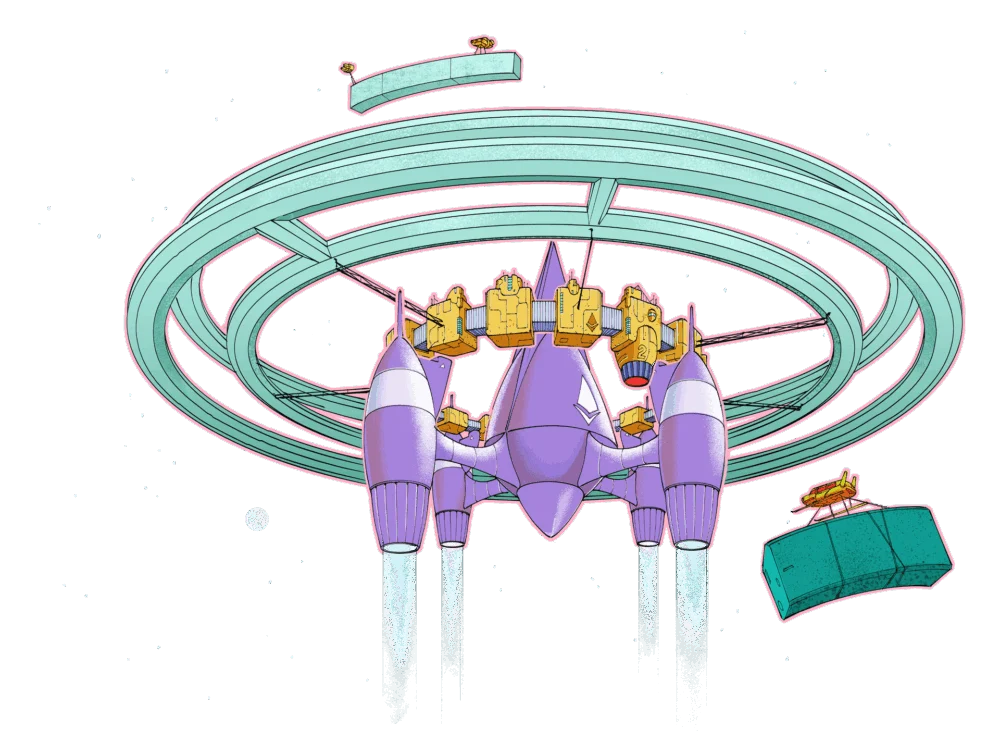
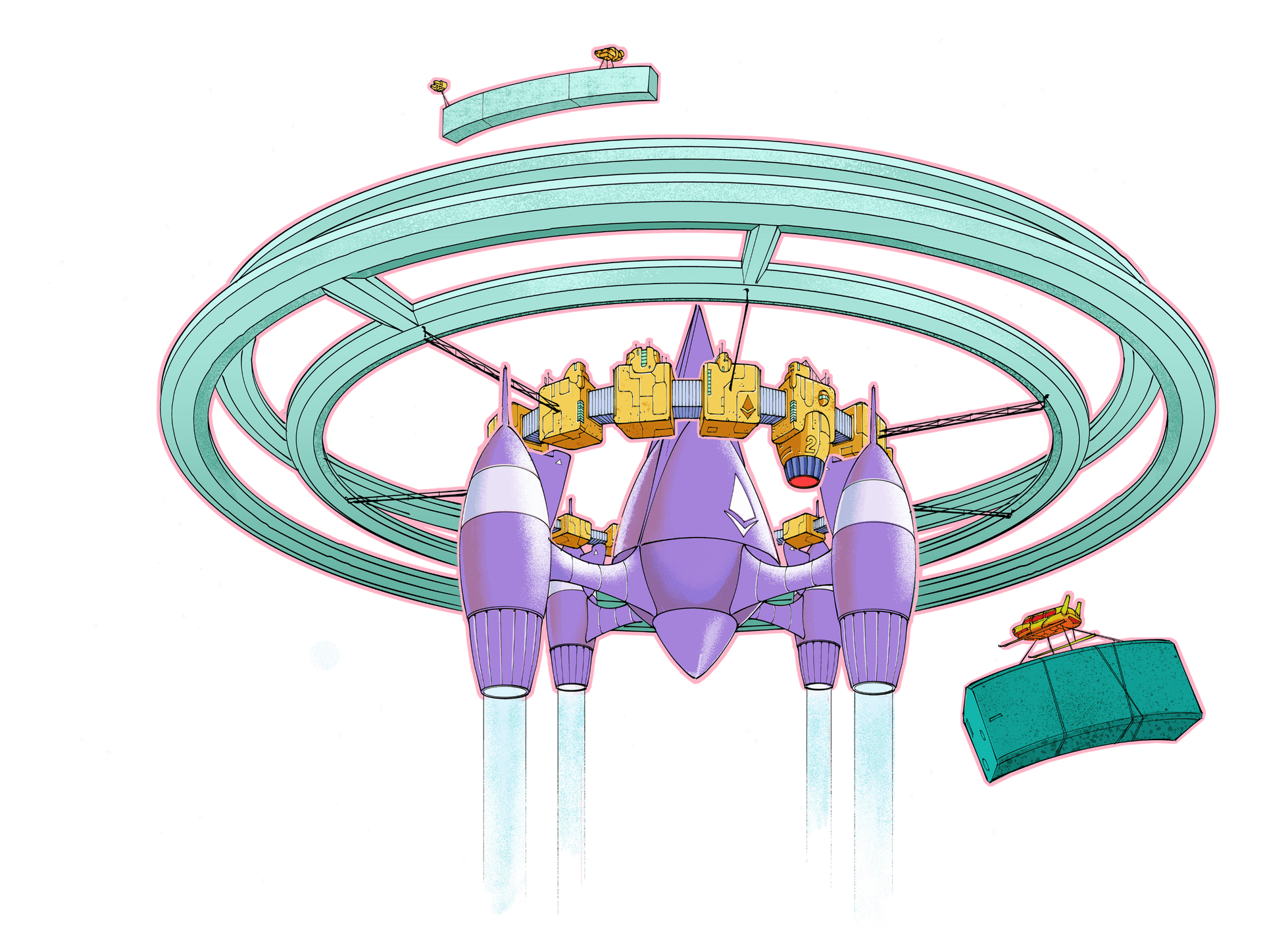
As the Ethereum network approaches its most significant upgrade since inception, the transition from Proof-of-Work (PoW) to Proof-of-Stake (PoS)—commonly referred to as "The Merge"—the global developer community is grappling with a critical structural vulnerability: client diversity. Ethereum, the world’s second-largest blockchain by market capitalization, currently secures hundreds of billions of dollars in decentralized finance (DeFi) protocols, non-fungible tokens (NFTs), and corporate assets. The upcoming transition has been likened by engineers to "replacing the engine of a jet while it is in mid-flight." For this operation to succeed, the network must maintain 100% uptime, as any cessation in valid block production could trigger catastrophic financial consequences.
Unlike the Bitcoin network, which relies primarily on a single dominant software implementation (Bitcoin Core), the Ethereum Foundation (EF) and its core developers have historically championed a multi-client philosophy. This approach involves developing several independent versions of the client software, each written in different programming languages by separate development teams. The goal is to ensure that a critical bug or security vulnerability in one codebase does not bring down the entire network. However, recent data suggests that the current distribution of these clients is dangerously skewed toward a single implementation: Prysm.

The Architectural Shift: Execution and Consensus Layers
To understand the risks associated with client diversity, one must first grasp the post-Merge architecture of an Ethereum node. Following the upgrade, a full Ethereum node will consist of two distinct layers working in tandem.
The first is the Execution Layer, which manages the Ethereum Virtual Machine (EVM). This layer handles the execution of smart contracts and transaction processing, essentially functioning as the "engine" that users interact with today. The second is the Consensus Layer (formerly known as Ethereum 2.0 or the Beacon Chain), which has been running in parallel since December 2020. This layer manages the Proof-of-Stake logic, handles validator duties, and ensures the network reaches agreement on the state of the blockchain.
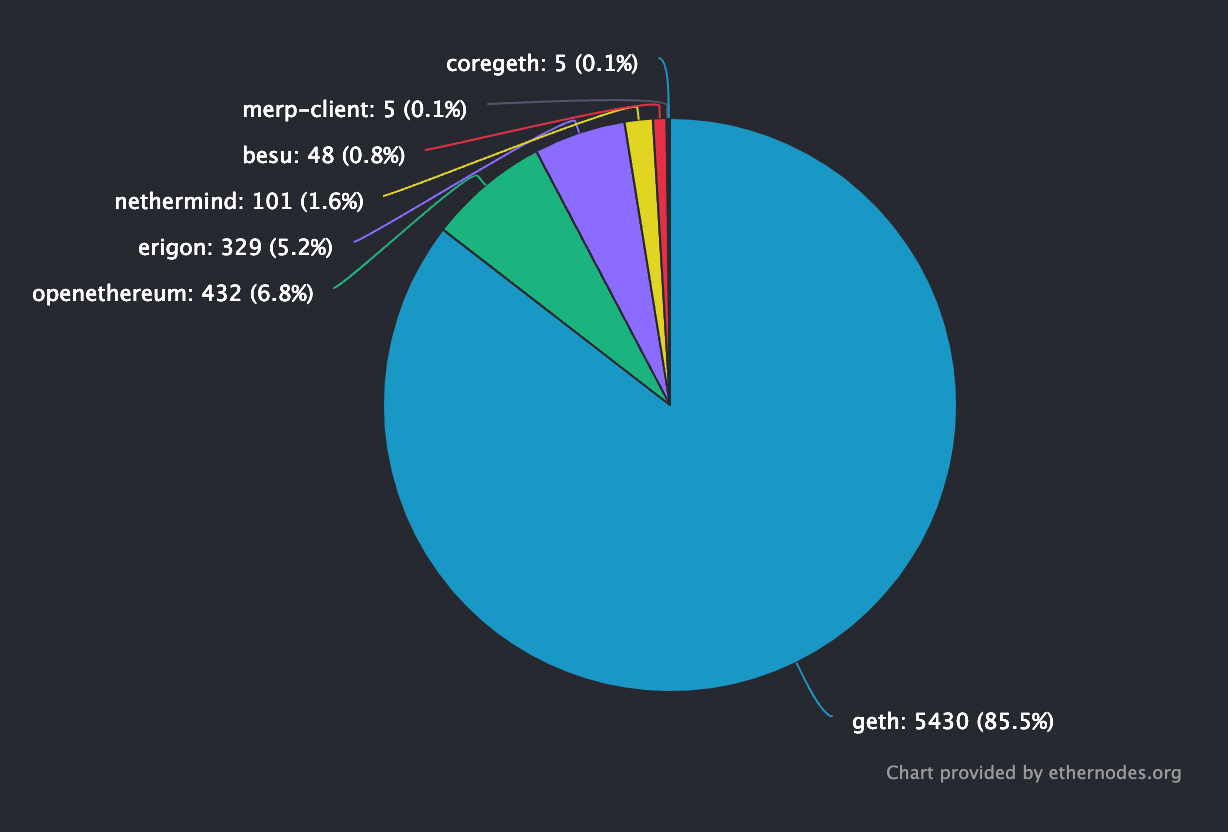
Post-Merge, these two layers will be linked via the Engine API. While the Execution Layer (dominated by the Geth client) handles the "what" of transactions, the Consensus Layer (where Prysm operates) handles the "how" of security and finality. If the Consensus Layer fails, the entire network loses its ability to finalize transactions, regardless of how well the Execution Layer is performing.
The Critical Thresholds of Consensus
The primary concern regarding the dominance of the Prysm client lies in the mathematical thresholds required for Proof-of-Stake consensus. In Ethereum’s PoS model, the network requires a two-thirds (66.6%) majority of staked Ether (ETH) to "finalize" a block. Finality is the point at which a transaction is considered irreversible.
The risks are tiered based on the market share of a single client:
- Below 33% (Safe Zone): If a client with less than one-third of the network’s stake suffers a bug or goes offline, the network continues to function normally. The remaining two-thirds can still reach consensus and finalize blocks.
- Between 33% and 50% (Caution Zone): If a client in this range fails, the network can no longer reach the two-thirds majority required for finality. While the chain will continue to grow, transactions will not be finalized until the issue is resolved. This triggers an "inactivity leak," where the offending validators are gradually penalized until their stake is reduced enough for the rest of the network to regain a two-thirds majority.
- Above 50% (Danger Zone): A client with a simple majority can cause a temporary fork in the chain, leading to significant disruption and potential financial loss for users caught on the "wrong" side of the fork.
- Above 66.6% (Critical Zone): If a client with a supermajority (more than two-thirds) contains a critical consensus bug, it can finalize an invalid chain. This is considered a "game over" scenario. In this instance, the buggy client would effectively force its version of reality onto the network. Non-buggy clients would be unable to stop this finalization, leading to a permanent split where the community must choose between a broken chain or a manual, socially coordinated "hard fork" to restore the network.
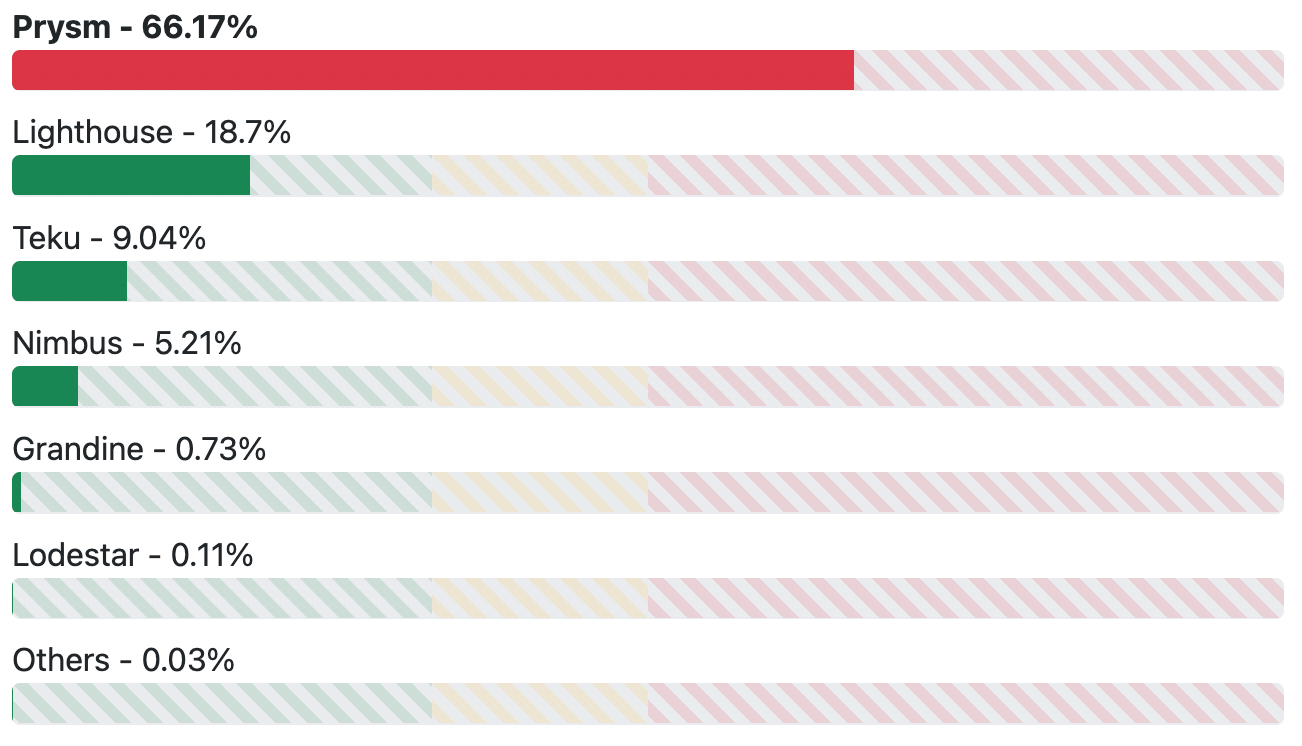
As of early 2022, Prysm’s market share has hovered near the 66% mark, placing the network on the precipice of this critical zone.
The Origins of Prysm’s Dominance
The dominance of Prysm, developed by Prysmatic Labs, is largely attributed to its "first-mover advantage." When the Beacon Chain was first conceptualized and tested, Prysm was the first implementation to offer a stable, production-ready prototype. This allowed the team to build a robust ecosystem of documentation, web-based user interfaces, and integration tools long before its competitors—Lighthouse, Teku, Nimbus, and Lodestar—reached maturity.
Furthermore, Prysm is written in Go (Golang), a programming language that is highly performant and widely used within the Ethereum ecosystem. Since Geth, the dominant execution client, is also written in Go, many developers and node operators found it easier to audit and manage Prysm’s codebase.
Marius van der Wijden, an Ethereum core developer, noted that this familiarity played a significant role in institutional adoption. "Devs familiar with Geth could also easily understand and audit Prysm," van der Wijden stated, explaining why large-scale operations gravitated toward the client.
Institutional Influence and the Staking Landscape
The concentration of staking power is not evenly distributed among individual "home validators." Instead, a massive portion of the staked ETH is controlled by centralized exchanges and liquid staking protocols. These entities have a disproportionate impact on client diversity.
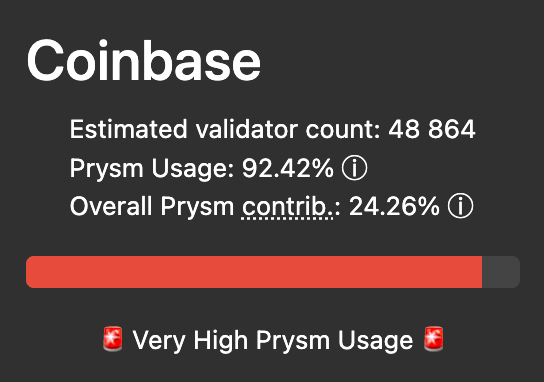
Data indicates that major players like Coinbase, Kraken, and Binance have historically relied heavily on Prysm. For instance, Coinbase Cloud, which services both retail and institutional clients, initially launched its staking services using Prysm exclusively. The company cited Prysm’s early support for "remote signers" as a primary reason for this choice. Remote signers allow validators to store private keys in isolated, secure environments rather than on the validator node itself, a feature critical for institutional security.
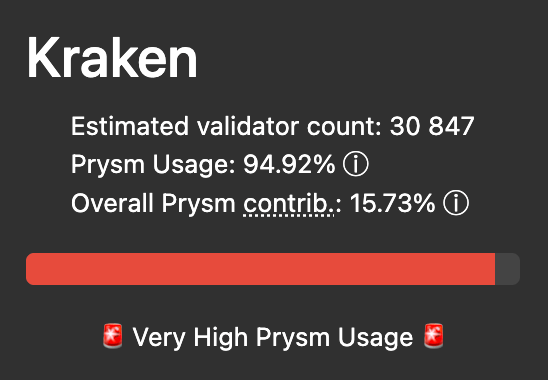
Similarly, Kraken’s usage of Prysm has been reported at over 94%, while Binance’s usage sits at approximately 76%. While these organizations have acknowledged the risk and begun diversifying—Kraken, for example, has started migrating validators to the Teku client—the sheer volume of their holdings means that any delay in migration keeps the network in a vulnerable state.
In contrast, decentralized alternatives like Rocket Pool have shown a much higher commitment to diversity. Rocket Pool validators utilize Prysm for only about 10% of their operations, distributing the remainder across Lighthouse, Teku, and Nimbus.
Chronology of the Transition
The path to The Merge has been a multi-year endeavor marked by rigorous testing:
- December 2020: The Beacon Chain launches, introducing PoS to the Ethereum ecosystem without yet processing user transactions.
- 2021: Multiple "devnets" and "shadow forks" are conducted to test the interaction between execution and consensus clients.
- Early 2022: The Kiln testnet becomes the final public testnet to undergo the Merge transition before the mainnet move.
- Mid-2022: The anticipated window for the Mainnet Merge, pending the resolution of final testing hurdles and the improvement of client diversity metrics.
Broader Implications and Safety Analysis
The central question remains: Is The Merge safe to pursue under these conditions? Within the developer community, the consensus is a cautious "yes," but with significant caveats.
Core developers have made it clear that there will be no "bailouts" for validators running a supermajority client. If Prysm (or any client with over 66% share) suffers a consensus bug that results in slashed funds, the protocol will not be altered to return those funds. This "social contract" is intended to incentivize large stakers to diversify their infrastructure immediately to protect their own capital.
Furthermore, the Ethereum Foundation has invested heavily in "fuzzing"—a process of automated software testing that provides random data to clients to find discrepancies in how they process information. This permanent testing infrastructure is designed to catch consensus bugs before they can reach the mainnet.
From an analytical perspective, the risk is not merely technical but economic. A failure of the Ethereum network would not only devalue ETH but could freeze billions in stablecoins like USDC and USDT, disrupt global NFT markets, and break the "money legos" of DeFi.
Conclusion: The Path Forward
The Ethereum community stands at a crossroads. While the technical readiness for The Merge is at an all-time high, the structural risk of client centralization remains a "black swan" threat. The responsibility for mitigating this risk lies largely with the major staking providers.
As the network moves toward its mid-2022 target, the focus has shifted from "can we merge?" to "how can we merge safely?" The ongoing discussions between the Ethereum Foundation and major exchanges suggest a coordinated effort to bring Prysm’s dominance below the critical 33% threshold. Whether this can be achieved before the final "Total Difficulty" trigger is reached will determine the stability of the new Ethereum era. For now, the transition continues, underpinned by the belief that the long-term benefits of a sustainable, secure, and energy-efficient blockchain outweigh the immediate risks of the migration.