admin
admin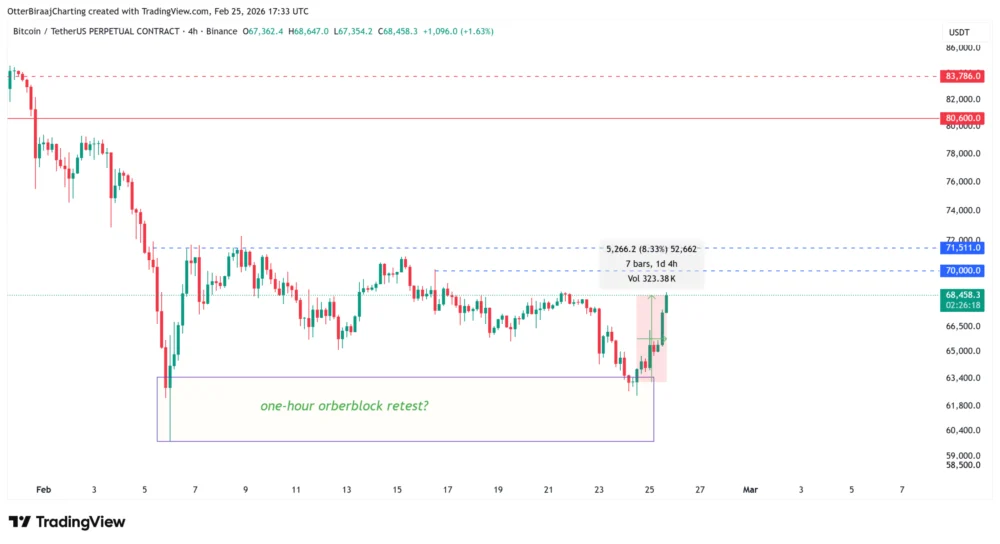
Bitcoin (BTC) embarked on a significant rally on Wednesday, ascending to a weekly high of $68,600. This impressive surge materialized from lows near $62,400 within a mere 24-hour period, marking a crucial inflection point after recent market turbulence. The cryptocurrency’s rebound was primarily underpinned by a confluence of factors: a notable return to net inflows for spot Bitcoin exchange-traded funds (ETFs) and an overall firming of macroeconomic sentiment. This improved sentiment followed recent signals from US policymakers, which contributed to a broader stabilization across risk markets, including equities and digital assets. Analysis of derivatives data further corroborated the health of this rally, indicating that the upward price movement was largely propelled by genuine spot market demand rather than an unsustainable buildup of leveraged positions, as evidenced by falling open interest and contained funding rates.
The Genesis of the Recovery: A Detailed Chronology
The period leading up to this rally had seen Bitcoin consolidate below its recent all-time highs, experiencing bouts of volatility and a sustained period of outflows from the newly launched spot Bitcoin ETFs. For five consecutive weeks, these institutional investment vehicles had recorded net redemptions, signaling a cooling of institutional appetite or profit-taking after an initial surge. This trend had exerted downward pressure on Bitcoin’s price, culminating in the dip towards the $62,400 mark.
The turning point began to materialize with a shift in the broader macroeconomic landscape. On Tuesday evening, market participants closely watched US President Donald Trump’s State of the Union address. While primarily a political address, such speeches are meticulously scrutinized by financial markets for cues on economic policy direction, fiscal outlook, and regulatory stability. President Trump’s remarks, which framed the initial 12 months of his leadership as an "economic turnaround for the ages," were particularly impactful. He highlighted positive economic indicators, including a significant decline in mortgage rates and a 1.7% drop in core inflation over the final three months of 2025.
These specific economic data points, coupled with the overall tone of the address, were broadly interpreted by financial markets as a sign of reduced near-term policy uncertainty. This perception was a welcome relief following a period characterized by heightened volatility stemming from discussions around potential tariffs and Supreme Court deliberations. The alleviation of this uncertainty acted as a catalyst, fostering an increased risk appetite across traditional equity markets, which historically often correlates with movements in the cryptocurrency sector. This macro-level shift created a fertile ground for Bitcoin’s subsequent price appreciation.
Spot Bitcoin ETFs: The Institutional Pivot

Perhaps the most direct and tangible driver of Bitcoin’s rally was the dramatic reversal in the flow of capital into spot Bitcoin ETFs. After a challenging period of sustained redemptions totaling an estimated $3.8 billion over five weeks, these ETFs recorded a substantial $257.7 million in net inflows on February 24th. This "positive flip" represented a critical shift in institutional sentiment, signaling renewed confidence and demand from sophisticated investors.
The inflows were not evenly distributed but showed strong participation from major players in the asset management industry. Fidelity’s spot Bitcoin ETF, a prominent contender in the market, drew approximately $83 million in fresh capital. Similarly, BlackRock’s iShares Bitcoin Trust (IBIT), which has consistently been a leader in attracting assets, added close to $79 million. Other issuers also contributed to the positive aggregate.
The significance of this reversal cannot be overstated. The launch of spot Bitcoin ETFs in early 2025 was hailed as a landmark event, opening the gates for traditional investors to gain exposure to Bitcoin without directly holding the asset. However, the initial euphoria was tempered by the subsequent weeks of outflows, primarily attributed to profit-taking by early investors and structural movements related to Grayscale Bitcoin Trust (GBTC) conversions. The return to net inflows suggests that the initial wave of selling pressure has subsided, and new institutional capital is actively seeking exposure to Bitcoin, viewing the recent dip as a buying opportunity. This institutional validation is crucial for Bitcoin’s long-term price stability and mainstream adoption, as it integrates the digital asset more deeply into traditional financial portfolios.
Derivatives Market Insights: A Healthy, Spot-Driven Rally
While the price action was dramatic, an examination of the derivatives market provided reassuring indicators that this rally was fundamentally sound and not built on excessive speculation. As Bitcoin traded near the $69,000 mark, aggregated open interest in Bitcoin futures stabilized around 235,167 BTC, having previously peaked above 240,000 BTC earlier in the week.
Open interest, which represents the total number of outstanding derivatives contracts that have not been settled, is a key metric for gauging market leverage. A drop in open interest, particularly after a period of volatility, suggests that "excess leveraged positioning" has been flushed out. This means that highly speculative, often over-leveraged long positions that bet on price increases were liquidated during the prior downturn, creating a healthier market structure less prone to cascading liquidations on minor price dips.
Concurrently, aggregated funding rates, which are periodic payments exchanged between long and short positions in perpetual futures contracts to keep the contract price pegged to the spot price, remained slightly negative at -0.0037%. Negative funding rates indicate that short positions are still paying long positions, which is counterintuitive during a strong price rally. This phenomenon signals that traders are not aggressively "chasing upside exposure" by piling into new long positions, despite the upward price movement. Instead, it suggests a degree of caution or a belief among some traders that the rally might be temporary, or simply a lack of widespread euphoria that often characterizes unsustainable pumps.

This combination of cooling open interest and negative-to-neutral funding rates is a powerful signal. It points to a market that has effectively "reset leverage" rather than one that is overheating. The rally toward $69,000, therefore, appears to be occurring without an aggressive buildup of new long positioning, implying that the underlying demand is coming from the spot market, which is generally considered a more stable and fundamental driver of price.
Further reinforcing this perspective, the cumulative volume delta (CVD) has shown an upward trend. CVD measures the net difference between buying and selling volume initiated by market orders. A rising CVD indicates that spot buyers are actively stepping into the market and are the primary architects of this rally. This direct buying pressure on exchanges, rather than speculative derivatives bets, lends more credibility and sustainability to the current price ascent.
The Role of Options Dealers and Order Book Dynamics
Beyond futures, the options market also offered nuanced insights into the market’s current structure. Market analyst BackQuant highlighted that derivatives activity, particularly in options, continues to play a significant role. According to BackQuant, options data indicated that dealers—the financial firms that sell options and hedge their exposure—were holding what is known as "positive gamma."
Positive gamma refers to a situation where a dealer’s delta (the rate of change of an option’s price with respect to the underlying asset’s price) becomes more sensitive to price movements. When dealers hold positive gamma, their hedging strategies typically involve buying the underlying asset (Bitcoin) as its price falls and selling it as its price rises. This behavior naturally acts as a stabilizing force in the market. It can smooth out volatility, absorb selling pressure on the way down, and temper sharp breakouts in either direction, preventing prices from running away too quickly or collapsing too rapidly. This suggests a more controlled and less parabolic ascent than previous rallies, potentially indicating a more mature market structure.
Complementing this, trader LP provided insights into Bitcoin’s order book dynamics, specifically around the crucial $60,000–$63,000 region. LP pointed out that strong bid pressure (buy orders) in this zone had previously absorbed significant selling pressure. This indicated a robust level of demand at those price points, preventing further downside. Since tapping that critical support zone, Bitcoin’s price has expanded roughly 8% to the upside, underscoring the effectiveness of that demand absorption.
However, LP also offered a cautionary note, emphasizing the importance of monitoring future order book activity. If sell pressure were to build again at these current higher levels, it could signal a slowdown in buy-side aggression, potentially triggering another lower reversal. This highlights the dynamic nature of market support and resistance, where previous strong buying areas can become points of contention if demand wanes.

Broader Impact and Implications for the Cryptocurrency Market
The recent rally and the underlying factors driving it have several significant implications for Bitcoin and the broader cryptocurrency market. Firstly, the return of net inflows into spot Bitcoin ETFs reinforces the narrative of institutional adoption. This suggests that despite initial volatility, major financial institutions and their clients continue to view Bitcoin as a viable, long-term asset class. The sustained interest from players like BlackRock and Fidelity lends considerable credibility to Bitcoin’s position in global finance. This trend is likely to continue, drawing more traditional capital into the digital asset ecosystem and potentially reducing Bitcoin’s historical volatility as its investor base diversifies.
Secondly, the nature of this rally—primarily driven by spot demand and characterized by a healthy derivatives market with deleveraging and contained funding rates—suggests a more sustainable growth trajectory. Unlike past bull runs that were sometimes fueled by speculative leverage, the current environment indicates a more organic and fundamental demand. This could lead to a more stable price discovery mechanism and reduce the risk of sharp, liquidation-driven corrections.
Thirdly, the increasing correlation between Bitcoin’s price action and broader macroeconomic sentiment, particularly US policy signals, highlights its growing integration into the global financial system. As Bitcoin matures, its sensitivity to traditional economic indicators like inflation, interest rates, and policy uncertainty is likely to increase. This means that investors will need to pay closer attention to global economic trends and central bank policies when assessing Bitcoin’s future prospects, blurring the lines between traditional and crypto market analysis.
Finally, the technical signals from options and order book analysis suggest a market that is becoming more sophisticated and potentially more resilient. The presence of positive gamma from dealers can help dampen extreme price swings, creating a smoother trading environment. The identification of strong bid walls in the order book provides visible levels of demand that can act as psychological and actual support. While always susceptible to market sentiment shifts, these elements point towards a market that is developing more robust internal mechanisms to manage volatility.
In conclusion, Bitcoin’s rally to $68,600 is more than just a price increase; it signifies a complex interplay of renewed institutional confidence via ETFs, a stabilizing macroeconomic environment, and a derivatives market that has deleveraged to support sustainable growth. As Bitcoin continues to navigate the intricacies of global finance, these factors will remain critical in shaping its trajectory and solidifying its position as a significant asset class.
This article does not contain investment advice or recommendations. Every investment and trading move involves risk, and readers should conduct their own research when making a decision. While we strive to provide accurate and timely information, Cointelegraph does not guarantee the accuracy, completeness, or reliability of any information in this article. This article may contain forward-looking statements that are subject to risks and uncertainties. Cointelegraph will not be liable for any loss or damage arising from your reliance on this information.