admin
admin
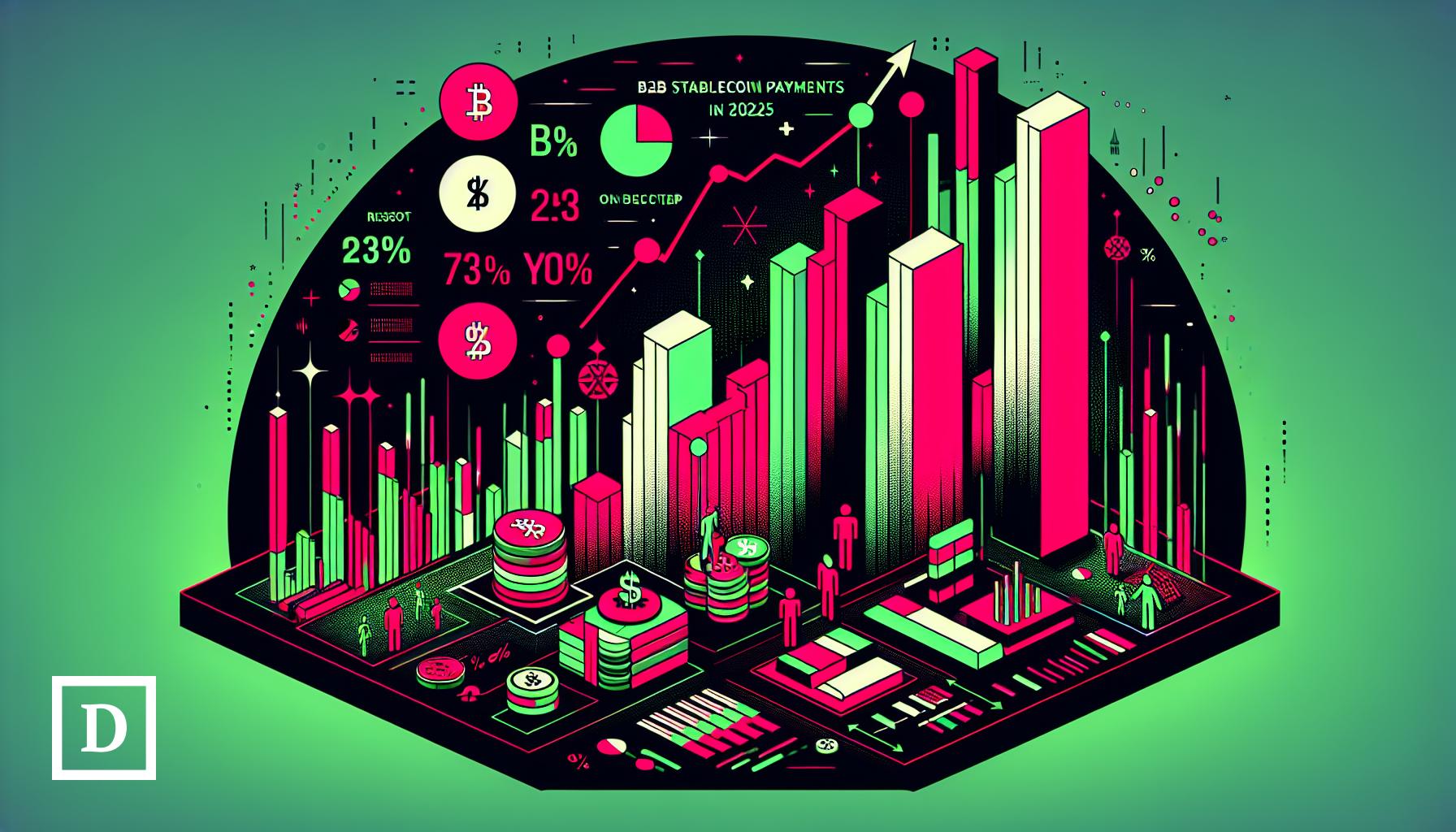
A groundbreaking report released by Artemis and Stablecon has illuminated a significant and accelerating trend within the global financial landscape: the burgeoning adoption of stablecoins by small to medium-sized businesses (SMBs) for business-to-business (B2B) transactions. Far from being confined to niche cryptocurrency circles, stablecoins are rapidly becoming a vital tool for companies across diverse sectors, from renewable energy manufacturing to automotive parts supply chains, signaling a fundamental shift in how businesses manage payments, particularly in cross-border scenarios. The report details an astonishing year-over-year growth of over 730% in B2B stablecoin payments in 2025, pushing total annual stablecoin payment volumes to an estimated $390 billion, more than double the previous year’s figures.
The Unprecedented Rise of Stablecoin Payments in 2025
The Artemis and Stablecon report, which analyzed transaction data throughout 2025, paints a compelling picture of stablecoin utility moving beyond speculative trading and into the realm of practical business operations. The headline figure of a 730% surge in B2B stablecoin payments underscores a profound and rapid integration of this digital asset class into mainstream commerce. This dramatic increase suggests that businesses, irrespective of their size, are actively seeking and implementing solutions that offer greater efficiency, speed, and cost-effectiveness in their financial dealings.
The total annual stablecoin payment volume estimated at $390 billion in 2025 represents a more than doubling compared to 2024. Crucially, B2B transactions accounted for approximately 60% of this massive sum, highlighting their dominant role in this growth trajectory. This indicates that the perceived advantages of stablecoins – such as near-instantaneous settlement and reduced transaction fees – are resonating deeply with businesses engaged in commercial exchanges.
Beyond B2B transactions, the report also observed remarkable growth in other payment categories. Card-linked stablecoin transactions, though representing a smaller fraction of the overall payment types, experienced an explosive increase of 840% year-over-year. This suggests that consumers and businesses are also finding innovative ways to integrate stablecoins into everyday spending, further broadening their accessibility and utility.
Global Hotspots for Stablecoin Inflows
The report identified key geographical hubs that are leading the charge in receiving stablecoin payments, particularly for cross-border transactions. The United States emerged as the dominant recipient, with monthly stablecoin inflows averaging nearly $127 billion. This significant volume suggests that American businesses are not only leveraging stablecoins for domestic transactions but are also actively using them to facilitate international trade and financial flows.
China followed as the second-largest recipient of international stablecoin payments, processing an average of nearly $71 billion per month. This positions China as a crucial player in the global stablecoin economy, likely driven by its extensive manufacturing base and its role in international supply chains. Hong Kong secured the third spot, with monthly inflows approaching $51 billion, underscoring its continued importance as a global financial and trading center.
The distribution of these inflows suggests that stablecoins are being channeled into economies with substantial payment volumes and robust international trade relationships. This challenges a prevailing narrative that often frames stablecoin usage primarily within emerging markets or for individuals seeking to circumvent traditional financial systems.
The Driving Force: Small to Medium-Sized Businesses
Andrew Van Aken, a data scientist at Artemis, provided crucial insights into the specific demographics driving this surge in stablecoin adoption. He emphasized that the adoption is not solely concentrated among large corporations but is significantly driven by small to medium-sized businesses (SMBs). These businesses, spanning a wide array of industries – from manufacturers of wind turbines and suppliers of auto parts to artisans creating scarves – are actively embracing stablecoins to overcome the limitations of traditional payment systems.
"I think the most important angle is that the top stablecoin countries tend to be the countries with the highest payment volumes," Van Aken stated in an interview with The Defiant. "While the narrative is often that stablecoins are used in emerging countries, developed countries are also looking for new and innovative payment methods."
Van Aken further elaborated on the motivations of these SMBs. "We can’t explicitly shed light on specifics, but it tends to be a lot of small to medium-sized businesses, often tech-forward businesses that are looking to decrease payment times," he added. This desire for reduced payment times is a critical factor. Traditional cross-border payments can often take several business days to settle, involving multiple intermediaries, fees, and potential currency conversion complexities. Stablecoins, by contrast, can settle transactions in minutes or even seconds, drastically improving cash flow management for businesses.
The Appeal of Speed and Efficiency in Cross-Border Transactions
The report directly links the rise in stablecoin use to their inherent ability to accelerate cross-border payments and streamline the often-cumbersome processes associated with traditional banking. For businesses, particularly SMBs that may lack the dedicated financial departments or resources of larger corporations, the efficiency gains offered by stablecoins can be transformative.
The traditional international payment system, while functional, is often characterized by:
- Multiple Intermediaries: Payments pass through correspondent banks, each adding processing time and fees.
- Settlement Delays: Funds can take days to clear due to banking hours, weekends, and differing national holidays.
- High Transaction Fees: Fees can be substantial, especially for smaller transaction amounts, impacting profitability.
- Currency Conversion Risks: Fluctuations in exchange rates during the settlement period can lead to unexpected losses.
- Lack of Transparency: Tracking the status of a payment can be challenging.
Stablecoins, by operating on blockchain technology, bypass many of these traditional hurdles. Transactions are recorded on an immutable ledger, providing transparency and near-instantaneous settlement. This allows businesses to finalize payments much faster, freeing up capital and reducing the risks associated with payment delays.
Context and Timeline of Stablecoin Evolution
The emergence of stablecoins as a significant payment tool is a relatively recent development, building upon the broader evolution of digital currencies. Initially, cryptocurrencies like Bitcoin were viewed primarily as speculative assets or a medium for peer-to-peer electronic cash. However, the inherent volatility of many cryptocurrencies made them unsuitable for everyday business transactions.
This led to the development of stablecoins – cryptocurrencies designed to maintain a stable value, typically pegged to a fiat currency like the U.S. dollar, or other assets. The first prominent stablecoin, Tether (USDT), was launched in 2014, followed by others like USD Coin (USDC) in 2018. Over the years, these stablecoins have gained increasing adoption and have seen their underlying technology and regulatory frameworks mature.
The period leading up to and including 2025 has been particularly pivotal. Increased institutional interest, greater regulatory clarity (though still evolving), and the development of user-friendly platforms have all contributed to the growing acceptance of stablecoins. The COVID-19 pandemic also accelerated digital transformation across all sectors, pushing businesses to explore new technologies for operational efficiency, including payment solutions. The data from Artemis and Stablecon suggests that the momentum generated during this period has now translated into substantial real-world usage for B2B payments.
Implications and Future Outlook
The findings of the Artemis and Stablecon report carry significant implications for the future of global commerce and finance:
- Increased Financial Inclusion: By lowering barriers to entry and reducing costs, stablecoins can facilitate greater participation in international trade for SMBs that might have been priced out by traditional systems.
- Enhanced Global Supply Chains: Faster and more reliable payment mechanisms can lead to more efficient and resilient global supply chains, reducing friction and improving responsiveness.
- Competitive Advantage for Early Adopters: Businesses that integrate stablecoins effectively can gain a competitive edge through improved cash flow, reduced operational costs, and enhanced customer and supplier relationships.
- Evolution of Traditional Finance: The growth of stablecoin adoption may pressure traditional financial institutions to innovate and offer more competitive services in areas like cross-border payments and transaction speed.
- Regulatory Scrutiny and Development: The increasing use of stablecoins will likely lead to further regulatory attention, with governments and financial authorities seeking to balance innovation with financial stability and consumer protection.
Van Aken’s observation that developed economies are actively seeking new payment methods is particularly noteworthy. It suggests that the appeal of stablecoins is not solely about bypassing existing systems but about enhancing them. Businesses in these economies are leveraging stablecoins as a modern, efficient, and cost-effective tool to complement or improve upon existing financial infrastructure.
While the report does not delve into specific company names or detailed case studies, the broad categorization of industries and the emphasis on SMBs provide a clear indication of the widespread impact. The mention of "windmills to scarf makers to auto part companies" illustrates that this is not an isolated phenomenon within a single sector but a cross-industry transformation.
The data presented in the report, coupled with expert commentary, paints a picture of a financial ecosystem in flux. Stablecoins, once considered a fringe innovation, are demonstrably transitioning into a mainstream financial instrument, driven by the practical needs and adoption strategies of businesses, particularly small and medium-sized enterprises seeking to optimize their payment processes and unlock new avenues for growth in an increasingly interconnected global economy. The continued trajectory of these trends will undoubtedly be a key area to monitor in the coming years.