admin
admin
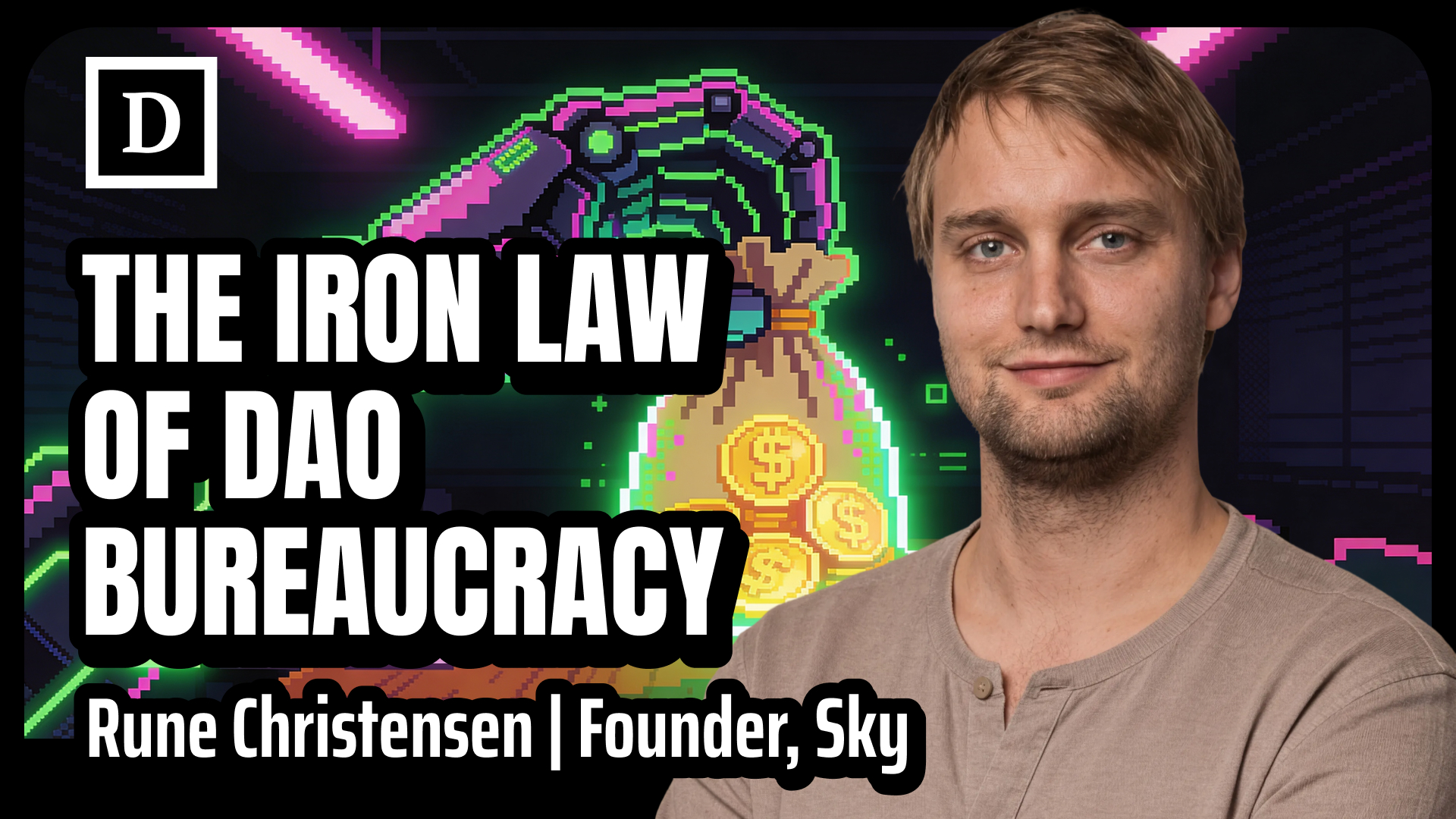
Rune Christensen, the visionary founder of MakerDAO, a pioneering decentralized autonomous organization (DAO) in the cryptocurrency space, recently articulated a profound observation: "In a decentralized governance system, it’s unavoidable to develop politics." This statement encapsulates a critical challenge facing the nascent world of Web3 and decentralized finance (DeFi), where the ideals of flat hierarchies and community-driven decision-making often collide with the inherent complexities of human organization. Christensen’s insights delve into the inevitable transformation of DAO governance into a struggle for resources, the emergence of what he terms the "iron law of bureaucracy" within these supposedly leaderless structures, and how MakerDAO has strategically redesigned its architecture – notably through its "Endgame" plan, often referred to internally by elements like "Sky" – in a proactive effort to survive these systemic pressures. His discourse offers a candid assessment of the journey from a utopian vision of decentralized governance to the pragmatic realities of managing large, valuable, and complex digital economies.
The Inherent Political Landscape of Decentralized Governance
At its core, a Decentralized Autonomous Organization (DAO) is an organizational structure governed by computer code and community consensus, typically facilitated by token-based voting. The promise of DAOs is to eliminate central points of control, foster transparency, and enable a truly democratic form of collective decision-making, where every token holder has a voice. MakerDAO, launched in 2017, stands as one of the earliest and most influential examples, responsible for creating Dai, the first decentralized stablecoin, and a cornerstone of the DeFi ecosystem. Its governance model, which involves MKR token holders voting on critical parameters like collateral types, stability fees, and risk management, has long been a benchmark for the industry.
However, as Christensen points out, even in such systems designed for decentralization, the human element introduces an unavoidable political dimension. As DAOs grow in scale, influence, and the sheer volume of assets under their management – MakerDAO’s treasury, for instance, has at times controlled billions of dollars in collateral and significant reserves – the stakes of governance decisions escalate dramatically. This creates a natural impetus for various stakeholders, including large token holders, core contributors, specialized teams, and external interest groups, to organize and advocate for their respective interests. This advocacy, often framed as promoting the best interests of the protocol, quickly devolves into a struggle for control over shared resources, strategic direction, and ultimately, power within the ecosystem. The allocation of development grants, marketing budgets, and even the fundamental technical roadmap becomes subjects of intense debate and lobbying, mirroring the political processes found in traditional organizations or nation-states.
The "Iron Law of Bureaucracy" in Decentralized Systems
Christensen’s reference to the "iron law of bureaucracy" is a direct nod to sociologist Robert Michels’ "Iron Law of Oligarchy." Michels, observing European political parties in the early 20th century, posited that all complex organizations, regardless of their democratic or revolutionary origins, eventually evolve into oligarchies. This occurs because the practical necessities of running a large organization – the need for specialized knowledge, efficient decision-making, and continuity – lead to the delegation of power to a smaller group of leaders or administrators. These individuals, initially serving the organization, gradually consolidate power and prioritize their own interests or the perpetuation of their roles, even at the expense of the organization’s original democratic ideals.
In the context of DAOs, this "iron law" manifests in several ways. While DAOs strive for flat structures, the sheer volume and technical complexity of governance proposals often necessitate the formation of specialized "Core Units," "sub-DAOs," or dedicated teams. These groups, composed of experts in areas like smart contract development, risk analysis, or community management, become indispensable for the DAO’s operation. Over time, these core contributors can become entrenched, developing specific workflows, internal cultures, and even a degree of institutional memory that makes them difficult to replace or challenge. They control the narrative around complex proposals, influence voting outcomes through expert opinions, and effectively become the de facto operational arm of the DAO. While essential for efficiency, this centralization of expertise and operational capacity can inadvertently create the very bureaucratic structures and power concentrations that DAOs were designed to circumvent.
Data on DAO participation often supports this observation. While many DAOs boast thousands of token holders, active participation in governance typically hovers in the low single digits, with a significant percentage of votes often controlled by a handful of large holders or delegated to a few prominent entities. For instance, data from platforms like Tally.xyz and Snapshot.org frequently show that proposals pass with a relatively small percentage of total token supply participating, and often a disproportionate amount of voting power concentrated among a few whales or delegates. This apathy or delegation, while understandable given the time and expertise required to engage meaningfully, further solidifies the influence of core groups and larger stakeholders, creating an effective oligarchy despite the democratic veneer.
MakerDAO’s Chronology of Governance Evolution and the "Endgame" Redesign
MakerDAO’s journey reflects a continuous struggle to balance decentralization with operational efficiency and resilience.
- Early Days (2017-2019): In its initial phase, MakerDAO’s governance was relatively simpler, focusing on parameters for a single-collateral Dai (SAI). Decision-making was primarily through token holder votes on simple proposals. The primary challenge was engaging enough voters and building consensus around critical risk parameters.
- Multi-Collateral Dai (MCD) and Initial Scaling (2019-2021): The transition to MCD significantly increased complexity, introducing multiple collateral types and requiring more sophisticated risk management. This period saw the informal emergence of specialized teams and individuals who naturally took on more responsibility for research, analysis, and proposal drafting, laying the groundwork for more formalized structures.
- Core Units and Decentralization Efforts (2021-2022): To formalize and decentralize operations, MakerDAO introduced "Core Units." These were self-organizing teams with budgets approved by the DAO, responsible for specific domains like engineering, risk, growth, or community. While intended to distribute power and responsibility, the Core Unit model also presented challenges. Coordination between numerous independent units became complex, and the potential for "siloing" or "turf wars" emerged. The increasing number of Core Units and their budgets also created a significant operational overhead and a complex web of internal politics around funding and strategic direction, validating Christensen’s observations about the struggle for resources.
- The "Endgame" Plan (2022-Present): Recognizing the limitations and the burgeoning bureaucracy within the existing structure, Rune Christensen spearheaded the development of the "Endgame" plan. This ambitious, multi-year architectural redesign is MakerDAO’s most significant response to the challenges of scaling decentralized governance and combating the iron law of bureaucracy. The Endgame aims to break down the monolithic MakerDAO into a network of smaller, semi-autonomous "MetaDAOs" or "SubDAOs," which Christensen might refer to with terms like "Sky" as a conceptual blueprint for this new architecture.
The core idea behind the Endgame is to create a modular, adaptable, and self-sustaining ecosystem. Instead of a single, large, and potentially bureaucratic DAO, the Endgame envisions a collection of specialized SubDAOs, each with its own governance tokens, treasury, and specific mandates (e.g., managing a particular stablecoin, developing new products, or focusing on real-world assets). These SubDAOs would interact with and contribute to the broader Maker ecosystem, governed by a simplified and more robust central protocol. The intention is to:
- Reduce Bureaucracy: By creating smaller, more focused entities, decision-making can be more agile and less prone to the inertia of a large, complex organization.
- Distribute Power: Empowering SubDAOs with their own governance and resources distributes influence more broadly than concentrating it within one large DAO.
- Enhance Resilience: A modular structure is more resilient to single points of failure, whether technical or political. If one SubDAO struggles, it doesn’t necessarily jeopardize the entire ecosystem.
- Incentivize Contribution: SubDAO tokens can better align incentives for contributors within those specific domains.
This architectural shift represents a fundamental rethinking of how large-scale decentralized organizations can function effectively without succumbing to the very centralized tendencies they aim to transcend. It’s an acknowledgment that while politics are unavoidable, the system can be designed to compartmentalize and manage them more effectively.
Broader Impact and Implications for Web3 Governance
Christensen’s observations and MakerDAO’s proactive response through the Endgame plan carry significant implications for the broader Web3 ecosystem. Many DAOs are grappling with similar issues of low voter participation, the concentration of power among core teams, treasury management disputes, and the challenge of scaling decision-making without sacrificing decentralization.
- The Scalability Trilemma of Governance: Just as blockchains face a scalability trilemma (decentralization, security, scalability), DAOs face a similar challenge in governance. It’s difficult to achieve high decentralization, strong security (resistance to attacks or capture), and efficient, scalable decision-making simultaneously. MakerDAO’s Endgame suggests a potential path: achieving scalability and efficiency through modularity, while maintaining decentralization across a network of interconnected entities.
- The Future of Decentralized Development: The Endgame model, if successful, could become a blueprint for how large protocols evolve. It suggests a future where a central, immutable protocol acts as a foundational layer, while innovation and operational execution occur in a more dynamic, decentralized network of specialized sub-organizations. This contrasts with traditional corporate structures or even the initial monolithic DAO vision.
- The Role of Leadership in Decentralization: Christensen’s role in initiating and driving the Endgame plan highlights a paradox: even in decentralized systems, visionary leadership often plays a crucial role in steering the ship, especially during critical transitions. The challenge then becomes how to transition from such centralized initiation to a truly decentralized, self-sustaining system.
- Education and Engagement: The complexity of these governance models underscores the ongoing need for improved user interfaces, better educational resources, and simplified participation mechanisms to encourage broader and more informed engagement from token holders. Without it, the "iron law" will continue to hold sway.
Experts in decentralized governance largely concur with Christensen’s diagnosis. "The notion that DAOs are immune to politics is naive," states Dr. Anya Sharma, a researcher specializing in organizational theory in Web3. "Any aggregation of human capital and resources will invariably develop power dynamics. The real innovation lies not in eliminating politics, but in designing systems that can channel these forces constructively, or at least mitigate their destructive potential." Similarly, Jordan Lee, co-founder of a prominent DAO analytics platform, notes, "We see consistent patterns across DAOs: initial enthusiasm, followed by the struggle to operationalize, and then the inevitable formation of influential groups. MakerDAO’s Endgame is a bold experiment to break that cycle by distributing complexity rather than consolidating it."
The path forward for DAOs is not about eliminating politics, but about understanding its inevitability and designing resilient architectures that can withstand and even leverage these forces. MakerDAO’s journey, from its initial promise to its current radical redesign, serves as a crucial case study for the entire Web3 space. Its "Endgame" strategy represents a sophisticated attempt to re-architect decentralization itself, moving beyond a monolithic ideal to a more pragmatic, modular, and robust network of self-governing entities. The success or failure of this ambitious undertaking will provide invaluable lessons for the ongoing quest to build truly decentralized, autonomous, and enduring digital organizations.