admin
admin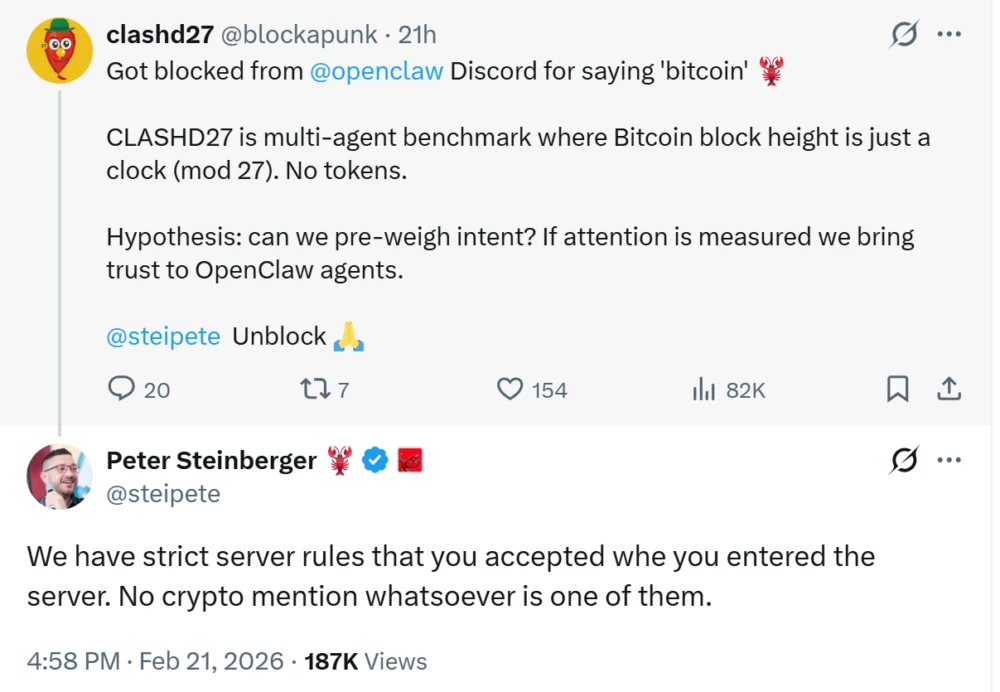
The developer behind OpenClaw, a rapidly ascending open-source AI agent framework, has unequivocally affirmed a stringent policy prohibiting any mention of Bitcoin or other cryptocurrencies on its official Discord server, a measure enforced through immediate removal. This directive came into sharp focus following an incident where a user reported being blocked from the community for merely referencing Bitcoin block height as a timing mechanism within a multi-agent benchmark, highlighting the framework’s zero-tolerance approach to digital assets.
The confirmation of this strict policy emerged on Saturday, following a public disclosure on X (formerly Twitter) by a user identified as "blockapunk." The user detailed their expulsion from OpenClaw’s Discord server, stating, "I was blocked from OpenClaw’s Discord for referencing Bitcoin block height as a timing mechanism in a multi-agent benchmark." This seemingly innocuous technical reference, common in various distributed systems and benchmarks, triggered an immediate and definitive response from the OpenClaw administration.
Peter Steinberger, the creator of OpenClaw, subsequently confirmed the action in a post on X, explaining the rationale behind the ban. He stated that all members, upon joining the Discord server, agree to "strict server rules" which explicitly include a "no crypto mention whatsoever" policy. This firm stance underscores a deliberate strategy by OpenClaw to distance itself entirely from the cryptocurrency sphere, a decision rooted in a tumultuous past incident involving a fraudulent token.
While the initial enforcement was rigid, Steinberger later showed willingness to de-escalate the individual incident, agreeing to reinstate the user. He requested the user to email their username, indicating a potential for discretion in specific cases while maintaining the overarching policy. This gesture, however, does not alter the core principle governing the community’s interaction guidelines regarding cryptocurrencies.
The Genesis of OpenClaw’s Anti-Crypto Stance: A $16 Million Scam
OpenClaw’s resolute aversion to cryptocurrencies is not arbitrary but stems from a costly and damaging incident that occurred during a critical rebranding phase. The trouble began when Steinberger received a trademark notice concerning the project’s original name, necessitating an immediate change. In the brief, vulnerable window between the relinquishment of old social media accounts and the successful claiming of new ones, malicious actors swiftly moved in. Scammers seized the abandoned handles and exploited the project’s burgeoning popularity to promote a fraudulent Solana-based token named $CLAWD.
This scam unfolded with alarming speed and effectiveness. The imposter token, leveraging the legitimate project’s brand recognition, surged dramatically, reaching an approximate market capitalization of $16 million within mere hours of its launch. This rapid ascent lured unsuspecting investors, many of whom were likely drawn by the perceived association with the legitimate OpenClaw project and the burgeoning interest in AI-related ventures. However, the illusion was short-lived. The token’s value plummeted by over 90% after Peter Steinberger publicly disavowed any involvement, unequivocally stating that the token was a scam and had no connection to OpenClaw. The aftermath left many early buyers financially devastated, leading to accusations and significant reputational damage for the legitimate project.
At the time of the incident, Steinberger took to social media to issue a stern warning, clarifying that he would never launch a cryptocurrency and that any token claiming association with him or OpenClaw was fraudulent. This public denial was a crucial step in damage control, but the repercussions extended beyond immediate financial losses. Security researchers, including firms like SlowMist, later identified hundreds of exposed OpenClaw instances online, alongside dozens of malicious plug-ins. A significant portion of these malicious tools were specifically designed to target cryptocurrency traders, further cementing the link between the OpenClaw brand and illicit crypto activities in the minds of many. This intricate web of scams and security vulnerabilities profoundly influenced Steinberger’s decision to implement the strict no-crypto policy, viewing it as a necessary measure to protect the project’s integrity, its community, and its reputation from further exploitation.
OpenClaw’s Meteoric Rise in the AI Agent Landscape
Despite, or perhaps in spite of, its contentious stance on cryptocurrencies, OpenClaw has experienced a truly meteoric rise in the artificial intelligence domain. Launched in late January, the open-source AI agent framework quickly captured the attention of the global developer community. Within weeks of its debut, the project surpassed an astonishing 200,000 GitHub stars, a significant metric indicating widespread interest and adoption among developers. This rapid growth underscores the immense appetite for tools and frameworks that facilitate the creation of autonomous AI agents – software entities capable of performing tasks independently, often by interacting with their environment and other systems.
The appeal of OpenClaw lies in its promise to empower developers to build sophisticated AI agents that can automate complex workflows, manage information, and even interact with real-world applications. Such agents are envisioned as the next frontier in AI, moving beyond static models to dynamic, goal-oriented entities. The framework’s success highlights a broader trend in AI development, where the focus is shifting towards creating more intelligent, self-sufficient systems that can operate with minimal human intervention. This burgeoning interest attracts a diverse developer audience, from hobbyists experimenting with new AI paradigms to seasoned professionals seeking robust tools for advanced applications. The project’s technical merits and the potential it offers for innovation are undeniable, which makes its strict policy regarding cryptocurrencies all the more striking against the backdrop of an industry increasingly exploring the convergence of AI and blockchain technologies.

The Broader Industry Context: AI Agents and Cryptocurrency Integration
OpenClaw’s firm stance against cryptocurrency mentions stands in stark contrast to a rapidly emerging trend within the broader tech and financial industries: the deep integration of AI agents with blockchain and cryptocurrency infrastructure. Many industry leaders increasingly view cryptocurrencies, particularly stablecoins, as the default payment rail and underlying trust layer for the burgeoning ecosystem of autonomous AI agents.
Jeremy Allaire, CEO of Circle, a prominent issuer of the USDC stablecoin, has been a vocal proponent of this convergence. He has publicly predicted that within a few years, billions of AI agents will routinely utilize stablecoins for micro-payments and transactional activities. Allaire envisions a future where AI agents, operating autonomously, will require efficient, low-cost, and programmable payment mechanisms to fulfill their tasks, whether it’s paying for compute resources, data access, or interacting with decentralized applications (dApps). Stablecoins, with their price stability and blockchain-native properties, are seen as ideal candidates for facilitating these high-volume, automated transactions.
Further underscoring this trend, Coinbase, one of the world’s largest cryptocurrency exchanges, recently unveiled its "Agentic Wallets" infrastructure. This innovative system is designed to allow AI agents to hold their own wallets and autonomously manage, spend, earn, and trade crypto on-chain. Built upon Coinbase’s AgentKit developer framework and powered by the x402 payments protocol, this system empowers software agents to perform a wide array of financial operations without direct human oversight. These capabilities include actively managing DeFi (Decentralized Finance) positions, rebalancing cryptocurrency portfolios based on market conditions, paying for cloud compute and data services, and participating in various digital marketplaces. The introduction of Agentic Wallets by a major player like Coinbase signifies a robust commitment to enabling AI agents to become active participants in the digital economy, leveraging the unique properties of blockchain technology for trust, transparency, and programmability.
Moreover, the concept of "trustless agents" built on platforms like Ethereum is gaining traction. Standards are being developed to enable AI agents to interact with smart contracts and decentralized networks in a secure and verifiable manner. This "Ethereum’s Trustless Agents standard" is often cited as a critical missing link for AI payments, providing the necessary infrastructure for agents to execute transactions reliably and without intermediaries. Companies like Deel, a global payroll platform, have also begun partnering with crypto firms like MoonPay to roll out stablecoin salary payouts in regions like the UK and EU, illustrating a broader move towards crypto as a legitimate and efficient payment rail, even for traditional financial operations.
These developments highlight a fundamental philosophical difference: while OpenClaw prioritizes brand protection and simplicity by excluding crypto entirely, a significant portion of the tech world views crypto as an essential, perhaps even inevitable, component for the future functionality and economic models of AI agents. The ability for agents to have their own wallets, execute payments, and participate in decentralized economies is seen by many as a foundational requirement for truly autonomous and economically viable AI systems.
Implications and Future Outlook
The OpenClaw incident and its subsequent policy enforcement carry significant implications for its community, the broader AI development landscape, and the ongoing convergence of AI and blockchain technologies.
For OpenClaw’s community, the "no crypto mention whatsoever" policy creates a clear boundary. While it might effectively shield the project from the specific type of scam that plagued it previously, it also potentially alienates a segment of developers who are actively interested in both AI agents and the cryptocurrency space. Many innovators see these two fields as deeply synergistic, with blockchain providing the necessary infrastructure for AI agent identity, reputation, data provenance, and programmable economics. By drawing such a hard line, OpenClaw risks becoming an outlier in a rapidly evolving ecosystem, potentially limiting its collaborative reach and the diversity of its developer base. The balance between protecting a brand and fostering an open, inclusive developer community is a delicate one, and OpenClaw’s current approach leans heavily towards the former.
From a broader industry perspective, this event serves as a stark reminder of the reputational risks associated with the crypto space, particularly for nascent projects. The rapid proliferation of scams and fraudulent tokens can have severe consequences for legitimate innovators, forcing them to adopt extreme measures for self-preservation. OpenClaw’s experience underscores the ongoing challenges of brand management and security in an environment where digital assets can be easily mimicked or exploited for illicit gain. It highlights the need for robust security protocols, clear communication strategies, and possibly even proactive legal measures for projects gaining significant traction.
The differing philosophies between OpenClaw and proponents of AI-crypto convergence also underscore a fascinating ideological divide within the tech community. On one side are those who view blockchain and cryptocurrencies as essential building blocks for the future of AI agents, enabling decentralized governance, economic incentives, and trustless interactions. On the other side are projects like OpenClaw, which, perhaps scarred by past experiences, opt for a more traditional, centralized, and controlled environment, prioritizing stability and brand integrity above all else.
In the long term, it remains to be seen whether OpenClaw will maintain this strict stance. As the AI agent ecosystem matures and the integration with blockchain technologies becomes more sophisticated and secure, the pressures to reconsider such a policy might grow. The potential benefits of programmable money and decentralized trust for AI agents are immense, and a project of OpenClaw’s prominence may eventually find itself at a crossroads: either adapt to the converging landscape or risk being isolated from significant innovation flows. For now, OpenClaw’s policy stands as a testament to the complex interplay between technological advancement, community management, and the enduring challenges of security and reputation in the digital age.