admin
admin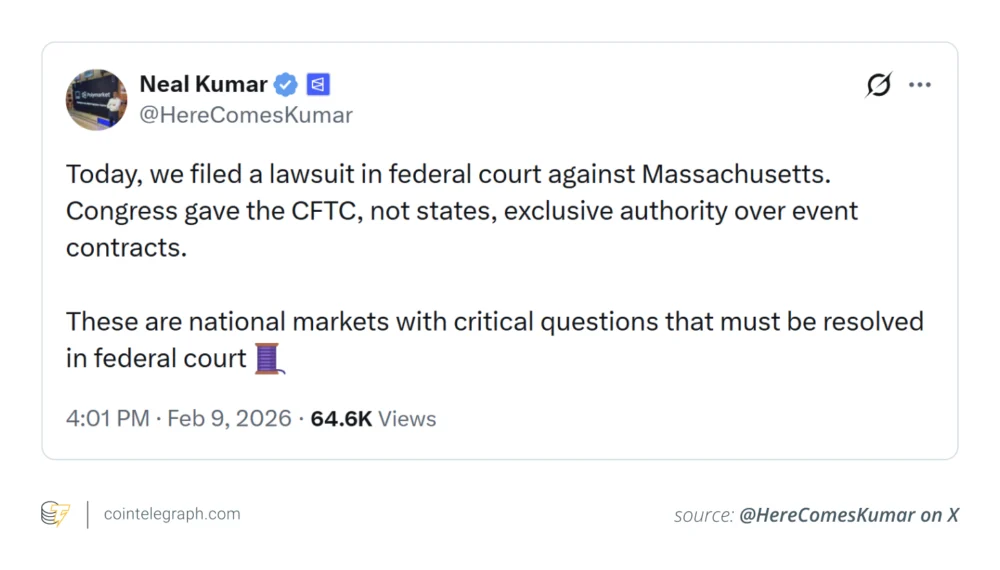
The landscape of event-based trading in the United States faces a pivotal moment as Polymarket, a prominent prediction market platform, has initiated a federal lawsuit against the Commonwealth of Massachusetts. Filed in February 2026 in the U.S. District Court for the District of Massachusetts, this legal challenge seeks to preempt state regulatory enforcement, arguing that Congress has granted exclusive authority over "event contracts" to the federal Commodity Futures Trading Commission (CFTC). The outcome of this high-stakes dispute could fundamentally reshape the regulatory framework for prediction markets across the nation, determining whether these innovative platforms operate under a unified federal umbrella or a fragmented system governed by individual state gambling laws.
This article delves into the intricacies of Polymarket’s federal lawsuit, exploring the core jurisdictional clash between federal and state authorities. It examines the historical context, the arguments presented by both sides, the broader implications for market access and innovation, and the potential future trajectory of event-based trading platforms in the US.
The Genesis of a Legal Showdown: A Chronology of Escalation
The current legal confrontation is not an isolated incident but the culmination of growing regulatory scrutiny faced by prediction markets in recent years. As these platforms gained traction, particularly with their ability to aggregate collective intelligence on diverse future events, state regulators began to raise questions about their legal classification.
Early 2020s: Rising Prominence and Scrutiny
Prediction markets, once niche academic tools, experienced a surge in public visibility and trading volumes throughout the early 2020s. Platforms like Polymarket and Kalshi facilitated trading on outcomes ranging from political elections and economic indicators to scientific breakthroughs and cultural events. Their increasing popularity, however, also drew the attention of state attorneys general and gaming commissions, many of whom viewed certain types of event contracts, especially those related to sports, as akin to unregulated gambling.
Massachusetts Targets Kalshi: A Precedent Set
The immediate catalyst for Polymarket’s federal lawsuit was Massachusetts’ aggressive stance against a rival platform, Kalshi. In late 2025, Massachusetts courts took action, effectively blocking Kalshi from offering sports-related contracts to state residents. A preliminary injunction was upheld, compelling Kalshi to prevent Massachusetts users from accessing these markets without holding a state-issued gaming license. The court explicitly directed that these specific markets be treated as unlicensed sports wagers, thereby subjecting them to the Commonwealth’s stringent gambling laws. This action sent a clear signal to the prediction market industry: states were prepared to enforce their own interpretations of these platforms.
Nevada Follows Suit: A Pattern Emerges
The Massachusetts action was not unique. Parallel efforts to curb prediction market operations emerged in other states, notably Nevada, a state with a highly developed and regulated gambling industry. Nevada regulators obtained a temporary restraining order against Polymarket’s sports-related offerings, asserting that they violated the state’s comprehensive sports betting regulatory framework. These coordinated state-level actions underscored a nascent but growing trend of state authorities seeking to exert control over prediction markets, particularly where they intersected with traditional sports wagering.
Polymarket’s Strategic Response: A Preemptive Strike
Facing a fragmented and potentially hostile regulatory environment, Polymarket chose a proactive legal strategy. By filing a federal lawsuit in February 2026, the company aimed to preempt further piecemeal enforcement by individual states. This strategic move sought to establish a definitive federal precedent, arguing that the Commodity Exchange Act (CEA) grants the CFTC exclusive jurisdiction, thereby nullifying state efforts to regulate or prohibit these markets. The timing was deliberate, designed to challenge the underlying legal principles being applied by states like Massachusetts before a patchwork of restrictive state laws could fully materialize.
Polymarket’s Stance: Derivatives, Not Gambling
At the heart of Polymarket’s legal challenge lies the assertion that its "event contracts," irrespective of their underlying subject matter—be it elections, economic data, or sports outcomes—are financial derivatives. As such, the company contends they fall squarely under the exclusive regulatory purview of the CFTC, as stipulated by the Commodity Exchange Act (CEA).
The Commodity Exchange Act and Federal Preemption
Polymarket’s legal team argues that the CEA explicitly grants the CFTC exclusive jurisdiction over "contracts of sale of a commodity for future delivery," as well as "swaps" and "event contracts." By classifying their offerings as legitimate financial instruments under federal law, Polymarket invokes the doctrine of federal preemption. This legal principle dictates that federal law supersedes state law when there is a direct conflict or when Congress has clearly intended to occupy a particular regulatory field. In Polymarket’s view, the CEA’s broad language and the CFTC’s established role in overseeing derivatives markets leave no room for states to independently ban or regulate these markets under their respective gambling statutes.
Neal Kumar, Polymarket’s chief legal officer, has been vocal about the company’s position. He emphasized that the dispute involves national markets, demanding a resolution in federal court rather than through disparate state-level rulings. "The legal questions at stake involve national markets and should therefore be resolved in a federal court, not through piecemeal enforcement by individual states," Kumar stated in a public address. He further stressed the potential long-term damage of state shutdown attempts, such as those initiated in Massachusetts and Nevada, arguing that they "miss a critical opportunity to foster innovation and help build the markets of tomorrow." From Polymarket’s perspective, these markets are not merely speculative games but valuable tools for information aggregation and risk management, deserving of a consistent, expert federal oversight.
Polymarket’s argument draws parallels with other regulated financial instruments, where the underlying "event" might seem speculative to an untrained eye but is nonetheless treated as a commodity or derivative under federal law. For instance, weather derivatives, which allow hedging against adverse weather conditions, are regulated by the CFTC despite their reliance on uncertain natural phenomena. Polymarket posits that event contracts, when structured appropriately, serve a similar function of allowing participants to hedge against or speculate on future outcomes, thereby providing price discovery and liquidity.
Massachusetts’ Defense: Safeguarding Consumers and State Sovereignty
Conversely, Massachusetts and other states involved in similar disputes maintain that when prediction markets resemble gambling, particularly those tied to sports or other leisure activities, they must comply with state gambling frameworks. Their primary concerns revolve around consumer protection, responsible gaming, and the preservation of state sovereignty in regulating activities within their borders.
The "Gambling vs. Investment" Dichotomy
From the perspective of the Massachusetts Attorney General’s office, certain prediction markets, especially those structured around sports outcomes, cross the line from financial derivatives into the realm of traditional sports wagering. State regulators argue that these platforms, without proper licensing and oversight, expose consumers to significant risks, including potential addiction, fraud, and a lack of transparency regarding odds and payouts. They contend that the protections afforded by state gambling laws—such as age verification, limits on wagers, responsible gaming initiatives, and strict licensing requirements for operators—are essential to safeguard residents.
An inferred statement from the Massachusetts Attorney General’s office might emphasize their commitment to protecting the state’s residents from unregulated gambling. "Our primary duty is to protect the consumers of Massachusetts," a spokesperson might articulate. "When platforms operate within our borders, offering what we classify as sports wagers without adhering to our established licensing and consumer protection laws, we are compelled to act. The federal government’s jurisdiction over financial derivatives does not automatically negate a state’s inherent authority to regulate gambling and safeguard its citizens." This viewpoint underscores the belief that even if the CFTC has some authority, it does not entirely preempt states from regulating activities that closely resemble gambling under their specific laws.
States also highlight the significant revenue generated by regulated gambling, which often funds public services. Allowing unregulated prediction markets to operate without contributing to these funds, while potentially siphoning off consumer spending, presents another point of contention. The existing state infrastructure for licensing, monitoring, and taxing gaming operations is robust, and states argue that prediction markets should integrate into this framework if they are to offer services that mimic traditional wagering.
The Ambiguous Role of the CFTC: A Federal Watchdog’s Dilemma
The Commodity Futures Trading Commission (CFTC), the federal agency at the center of this jurisdictional tug-of-war, finds itself in a complex and sometimes contradictory position. While the agency has a long-standing mandate to regulate derivatives markets, its approach to prediction markets has been marked by both cautious engagement and strategic avoidance.

Historical Engagement and Limitations
Historically, the CFTC has regulated various forms of event contracts, often through a "no-action" letter process or by granting limited approvals to platforms. For instance, Kalshi, prior to the Massachusetts injunction, had received some CFTC approval for certain types of event contracts. However, these approvals often came with strict conditions, limiting the types of events traded, ensuring robust market design, and sometimes prohibiting contracts related to highly sensitive or politically charged outcomes, such as elections, assassinations, or acts of terrorism. This cautious approach reflects the CFTC’s balancing act between fostering innovation in financial markets and upholding its mandate to prevent market manipulation, fraud, and illegal gambling.
Internal and External Pressures
The CFTC faces significant internal and external pressures regarding prediction markets. Internally, there can be differing interpretations of what constitutes a legitimate "event contract" versus an illegal "gambling contract." The line can be blurry, particularly when contracts involve outcomes that are also common subjects of traditional betting (e.g., sports, celebrity events). Externally, the agency has faced pressure from Congress, industry stakeholders, and even other federal agencies. Some lawmakers have urged the CFTC to either clearly define its regulatory scope or to stay out of disputes involving politically sensitive contracts.
Furthermore, the CFTC’s resources are finite. Taking on comprehensive oversight of a rapidly evolving and potentially controversial market segment like prediction markets would require significant investment in staff, expertise, and enforcement capabilities. This might explain why the CFTC has, at times, appeared hesitant to issue definitive, overarching regulations that would fully preempt state actions, preferring a more case-by-case approach or waiting for clearer legislative guidance. In the Polymarket v. Massachusetts case, the CFTC’s decision on whether to file an amicus brief or otherwise weigh in will be closely watched, as it could signal the agency’s broader strategic intent.
The Broader Landscape: A Patchwork of State Actions
The legal battles in Massachusetts and Nevada are indicative of a wider trend. The lack of clear federal guidance has created a regulatory vacuum that states are increasingly attempting to fill, leading to a fragmented and inconsistent legal environment for prediction markets across the United States.
Challenges for National Platforms
For platforms like Polymarket, which aim to operate on a national scale, this "patchwork" of state-specific rules presents significant operational and legal challenges. Compliance with 50 different sets of state gambling laws, each with unique licensing requirements, age restrictions, and definitions of what constitutes "gambling," is a monumental task. It could force platforms to geofence users, offer different contracts in different states, or even withdraw entirely from certain jurisdictions, severely limiting market access and stifling growth. This contrasts sharply with federally regulated financial markets, where a single set of rules typically applies across state lines, facilitating national market integration.
Precedent from Other Emerging Industries
This federal-state conflict is not unique to prediction markets. Similar jurisdictional disputes have arisen in other emerging industries, such as online fantasy sports and the cannabis industry. In fantasy sports, some states have deemed them games of skill, while others have classified them as illegal gambling, leading to a complex regulatory landscape that varies significantly from state to state. The cannabis industry, still federally illegal but legalized in many states, represents an even more stark example of this tension. These precedents highlight the challenges of regulating innovative industries that straddle traditional legal categories and the often-protracted nature of resolving such conflicts. The Polymarket lawsuit could establish an important legal precedent for how these types of federal-state conflicts are resolved in the digital age.
The Economics and Utility of Prediction Markets: Beyond Betting
Beyond the legal arguments, understanding the inherent value and economic utility of prediction markets is crucial for appreciating the stakes involved in this regulatory debate. These platforms are not merely digital casinos; they serve a variety of functions that extend far beyond casual betting.
Explosive Growth and Market Dynamics
Prediction markets have demonstrated explosive growth, moving from niche academic experiments to a significant, albeit still nascent, segment of the financial technology landscape. Data tracked by Dune analytics, for instance, showed that prediction markets collectively recorded approximately $3.7 billion in trading volume in a single week in January 2026, marking an all-time high. This volume was driven by a diverse array of contracts, including major political events, cryptocurrency price movements, technological milestones, and even the outcomes of major cultural awards. The growing liquidity and participation indicate a robust demand for mechanisms that allow individuals to express and trade on their beliefs about future events. The user base spans from sophisticated traders seeking alpha to everyday individuals interested in current events, contributing to a vibrant and dynamic market ecosystem.
Corporate Use Cases: Internal Forecasting and Strategic Intelligence
While often highlighted for their public-facing markets, prediction markets have a long history of quiet adoption within corporations for internal forecasting and strategic intelligence. Companies have leveraged these platforms to predict everything from the launch dates of new products and internal project deadlines to the success rates of marketing campaigns and employee retention. The aggregated opinions of a diverse crowd, often incentivized by small monetary rewards, frequently outperform traditional executive forecasts or expert panels. For example, a major tech company might run an internal market on the likely release date of its next-generation smartphone, collecting real-time, incentivized predictions from engineers, marketing teams, and supply chain managers. This collective intelligence can help management make more informed decisions, allocate resources more efficiently, and mitigate risks.
Academic and Research Value: Collective Intelligence and Information Efficiency
For decades, universities and research institutions have studied prediction markets as powerful tools for measuring collective intelligence and information efficiency. Studies have repeatedly shown that these markets, when designed well, can rival or even outperform traditional opinion polls in forecasting election outcomes, public health crises, and scientific breakthroughs. The underlying principle is that by attaching a monetary incentive to accurate predictions, markets encourage participants to reveal their true beliefs and incorporate all available information into their "bets." Researchers analyze these markets to understand how information propagates, how biases are mitigated, and how the "wisdom of crowds" can be harnessed. The data generated by prediction markets provides a rich source for econometric and behavioral studies, offering insights into human decision-making under uncertainty.
Technological Underpinnings: Blockchain and Smart Contracts
The rise of modern prediction markets, particularly platforms like Polymarket, is inextricably linked to advancements in blockchain technology and smart contracts. These markets are typically structured using decentralized protocols, where smart contracts automatically settle trades once an outcome is verified. This automation offers several advantages: it significantly reduces counterparty risk, enhances transparency, and lowers operational costs. Participants can have greater confidence that their contracts will be executed fairly and promptly without the need for a trusted third-party intermediary for settlement. However, this reliance on technology also introduces new regulatory and technical challenges, such as ensuring the reliability and neutrality of "oracles" (external data feeds that verify outcomes) and addressing the inherent security risks associated with smart contract code.
Potential Outcomes and Far-Reaching Implications
The Polymarket v. Massachusetts lawsuit represents a landmark case whose resolution will have profound and lasting implications for the prediction market industry, regulatory bodies, and the broader landscape of financial innovation.
If Federal Courts Side with Polymarket:
A victory for Polymarket would significantly strengthen the doctrine of federal preemption in this domain. It would likely pave the way for a more uniform national regulatory framework, potentially solidifying the CFTC’s role as the primary oversight body for event contracts. This outcome would be a boon for prediction market platforms, allowing them to scale more easily across state lines without the burden of navigating disparate state laws. It would also foster innovation by providing regulatory clarity and reducing compliance costs. However, it could also create challenges for states, limiting their ability to enforce local consumer protection standards and responsible gaming initiatives, which they argue are crucial for public welfare. States might also view it as an erosion of their traditional authority over gambling.
If Massachusetts’ Authority is Upheld:
Conversely, a ruling in favor of Massachusetts would affirm the states’ authority to regulate prediction markets under their respective gambling laws. This would almost certainly lead to the feared "patchwork" regulatory environment, where the legality and operational parameters of prediction markets vary dramatically from state to state. Platforms might be forced to withdraw from certain jurisdictions, significantly alter their offerings, or implement complex geofencing technologies to comply with local rules. This could stifle the growth of the industry, fragment markets, and make it difficult for platforms to achieve economies of scale. It would also empower states to define and regulate new forms of digital wagering, potentially setting a precedent for other emerging fintech innovations.
A Middle Ground or Legislative Action:
It is also possible that the courts could pursue a middle ground, perhaps distinguishing between different types of event contracts (e.g., those primarily financial vs. those primarily entertainment-focused) or requiring a hybrid regulatory model. In such a scenario, the CFTC might regulate the core financial aspects of these markets, while states retain some oversight on consumer protection, age verification, or specific categories of contracts deemed more akin to traditional gambling. Alternatively, the ongoing legal battles could spur legislative action at the federal level. Congress might step in to clarify the jurisdictional boundaries, either by explicitly granting the CFTC broader authority or by creating a new regulatory framework that acknowledges both federal and state interests. This would provide the most definitive resolution, albeit one that could be slow to materialize given the complexities of legislative processes.
The Future of Event-Based Trading
The Polymarket lawsuit is more than just a dispute over prediction markets; it is a critical test case for how legal and regulatory frameworks adapt to rapid technological innovation. It forces a fundamental reevaluation of what constitutes a "commodity," a "derivative," and "gambling" in the digital age.
The ultimate decision will determine the balance regulators strike between fostering innovation and safeguarding the public. If innovation is overly constrained by a fragmented and conservative regulatory approach, the US risks falling behind other nations in developing these novel financial tools. Conversely, an overly permissive approach could expose consumers to undue risks. The implications extend beyond prediction markets, potentially shaping how fintech, decentralized finance (DeFi), and other online trading platforms are regulated in the coming decades. It underscores the broader challenge of federalism in a digitally interconnected world, where national markets often clash with localized legal traditions. Whatever the outcome, this landmark case will undeniably leave an indelible mark on the future of event-based trading and the regulatory landscape of emerging digital economies in the United States.