admin
admin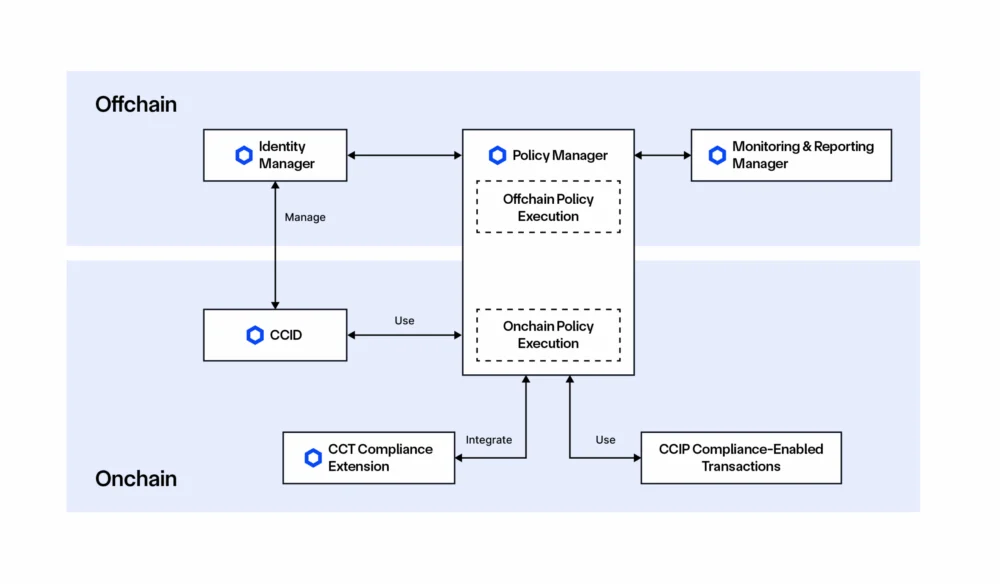
The rapid and accelerating growth in onchain finance is poised to revolutionize global markets, promising enhanced automation, improved robustness, and significantly lower costs across financial operations. This transformative shift offers a tantalizing future where individuals, businesses, financial institutions, and governments can achieve their financial goals with unprecedented efficiency and accessibility. However, the realization of this potential hinges critically on the ability of onchain finance to scale safely and sustainably within established regulatory perimeters. In the realm of institutional finance, the development of secure and compliant systems is not merely an advantage but an absolute imperative. For years, the inherent complexities of multiple blockchains, decentralized applications, and pseudonymous participants, coupled with a landscape of evolving regulatory expectations, have presented significant hurdles, often preventing market participants from fully leveraging these innovative technologies. These trade-offs—between innovation and compliance, efficiency and security—threaten to throttle the expansion of onchain finance or push it into unregulated territories if left unaddressed.
Recognizing this pressing concern, both global regulators and regulated market participants have vociferously called for robust, scalable solutions. Emerging as a pivotal answer to this demand is the Chainlink Automated Compliance Engine (ACE). This sophisticated suite of tools directly addresses the challenge of bringing institutional-grade compliance to the inherently complex world of decentralized finance. Various regulatory bodies and central banks, through numerous trials and proofs of concept, have explored the foundational principles that ACE now brings to production readiness. ACE not only integrates the key aims of these test cases but extends them, providing a comprehensive framework designed to ensure that onchain finance can achieve compliance at scale, efficiently, and with a high degree of standardization and interoperability, fostering trust and enabling widespread institutional adoption.
The Foundational Imperative: Bridging Innovation and Regulation
The promise of onchain finance, driven by advancements in blockchain and distributed ledger technology (DLT), is immense. Analysts project the tokenization of real-world assets to reach trillions of dollars in market value within the next decade, with some estimates suggesting a market size of $16 trillion by 2030. This growth is fueled by the inherent benefits of DLT: immutability, transparency, programmability, and disintermediation, which collectively can streamline processes, reduce settlement times, and unlock new forms of liquidity.
However, the very features that make DLT revolutionary also introduce novel regulatory challenges. Traditional financial regulations, built for a centralized, intermediary-heavy system, struggle to adapt to decentralized, pseudonymous, and cross-border transactions. Key concerns for regulators include:
- Anti-Money Laundering (AML) and Know Your Customer (KYC): Identifying counterparties in a pseudonymous environment is crucial to prevent illicit financial activities.
- Market Integrity and Stability: Ensuring fair trading practices, preventing market manipulation, and safeguarding financial stability are paramount.
- Consumer Protection: Protecting investors from fraud, operational risks, and market volatility.
- Cross-Jurisdictional Consistency: Harmonizing regulations across different legal frameworks for global operations.
- Data Privacy: Balancing the transparency of public blockchains with stringent data privacy laws like GDPR.
Without a robust and standardized approach to compliance, institutional players, who operate under strict regulatory mandates, have been hesitant to fully embrace onchain finance. This hesitation creates a significant bottleneck, preventing the technology from reaching its full potential.
Introducing Chainlink ACE: A Comprehensive Compliance Solution
At its core, Chainlink ACE is built upon the industry-standard oracle platform, Chainlink, renowned for securely connecting blockchains, offchain systems, and real-world data into end-to-end workflows. The Chainlink platform itself is structured around four critical pillars: Data, Interoperability, Compliance, and Privacy. ACE forms the very backbone of the compliance standard within this ecosystem.
ACE’s architecture is underpinned by its core component, Cross-Chain Identity (CCID), and is powered by a suite of services enabling identity orchestration, programmable policy enforcement, and real-time monitoring and reporting across disparate blockchain networks.
Cross-Chain Identity (CCID): The Foundation of Trust
Much of financial compliance relies on accurate identification of participants or, at minimum, robust attestation that they are permitted to engage in specific transactions. CCID provides a reusable, standardized identity framework. It enables the representation of investor identities, attestations, and credentials across multiple blockchains by storing cryptographic proofs of verified credentials onchain. This includes essential compliance data such as KYC, AML status, accredited investor status, and other regulatory requirements. Crucially, CCID is designed to be compatible with existing identity standards (e.g., ON-CHAINID, EAS) and leverages Chainlink’s Cross-Chain Interoperability Protocol (CCIP) to convey necessary information, all while ensuring that sensitive personal information remains securely offchain, addressing critical privacy concerns.
Core Services: Orchestrating Onchain Compliance
While CCID provides the foundational identity layer, ACE delivers a suite of higher-level services designed to solve practical business problems for financial institutions:
- Identity Manager: This service acts as the bridge between real-world identity sources and various onchain formats, including CCID and other established standards. It facilitates the registration, distribution, synchronization, and lifecycle management of identity credentials across diverse networks. A key feature is its ability to perform these functions without storing Personally Identifiable Information (PII) or Non-Public Information (NPI) directly onchain, aligning with data privacy regulations.
- Policy Manager: This customizable rules engine is central to ACE’s enforcement capabilities. It allows users to define, manage, and enforce complex compliance policies directly within smart contracts, with the flexibility for both onchain and offchain execution. Policies can be configured to satisfy regulatory requirements (e.g., KYC/AML checks, allow/deny lists for sanctioned entities) or internal business rules (e.g., secure minting protocols, transaction limits, collateral requirements for specific assets). This programmability is vital for adapting to evolving regulatory landscapes.
- Monitoring and Reporting Manager: A critical component for oversight and accountability, this service observes non-compliance issues, identifies risk concentrations, and detects other anomalies in real-time. It facilitates instant alerts, proactive risk mitigation, and strengthens operational resilience. Furthermore, it enables institutions to generate comprehensive reports essential for both internal auditing and regulatory submissions. This manager can answer complex questions such as: Is a token or market functioning correctly? Have compliance rules been exploited? Is a token circulating in a proscribed jurisdiction or among unauthorized holders?
This integrated architecture ensures that compliance is not an afterthought but an intrinsic part of the onchain financial workflow, operating across identity, policy, and execution layers in both cross-system and cross-chain environments.
Following Regulators’ Lead: ACE’s Alignment with Global Initiatives
Chainlink ACE is not merely an isolated technological innovation; it is a direct response to, and an embodiment of, the thought leadership emanating from leading regulatory authorities and central banks worldwide. These institutions have actively explored the intersection of DLT and finance through numerous pilot projects, shaping the industry’s understanding of necessary innovations and best practices. ACE incorporates the lessons and objectives from these significant initiatives, positioning itself as a production-ready system backed by a growing ecosystem of users, partners, asset issuers, and operators.
-
Purpose-Bound Money (PBM) and Token Fungibility:
The Monetary Authority of Singapore (MAS), among others, has grappled with the implications of programmable money. While programmability offers significant benefits, there’s a risk that overly complex or restrictive digital money could fragment liquidity and undermine its fundamental role as a medium of exchange. MAS introduced the concept of "Purpose-Bound Money" (PBM), where a relatively "simple" digital money is wrapped within a more elaborate token containing specific programming logic. Once conditions are met, the digital money becomes "unbounded" again.
ACE draws heavily on this intuition through its use of the Cross-Chain Token Standard (CCT), seamlessly blended with the widely adopted ERC-3643 standard. CCT is token logic agnostic, allowing for a wide variety of innovative tokens while retaining core functionality (e.g., ERC-20, ERC-3643 tokens). CCT enables programmable transfers, allowing tokens and messages to be transferred in a single transaction across multiple chains, thereby promoting multi-chain interoperability and fungibility. By collaborating with the ERC-3643 association and advocating for consistent token standards, Chainlink is laying the groundwork for programmable, yet fungible, tokenized assets at scale, directly addressing the concerns raised by MAS and others about market fragmentation.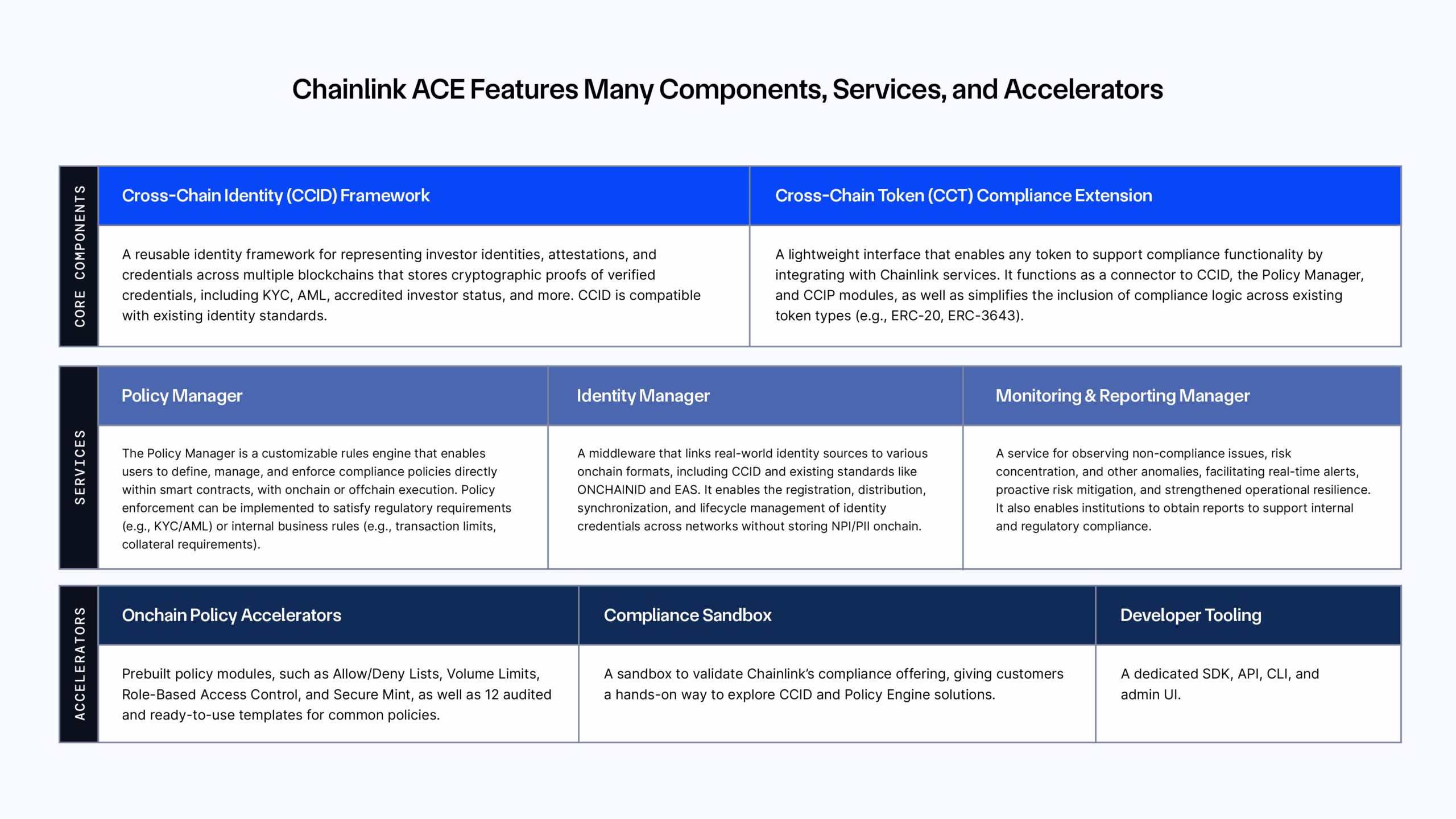
-
Project Pyxtrial: Enhancing Stablecoin Monitoring:
The BIS Innovation Hub (BISIH) London’s Project Pyxtrial highlighted the critical importance of timely and detailed information for ensuring the safety and soundness of stablecoins. This proof-of-concept monitoring tool focused on collecting and processing both on- and offchain data to monitor stablecoin balance sheets effectively.
Chainlink’s Proof of Reserve and Proof of Composition services are ideally suited to meet these requirements and are deployable within the ACE suite. Real-world examples, such as TrueUSD, Wenia, and IDA’s HKDA stablecoin, already integrate Chainlink Proof of Reserve for "secure mint" functionality, preventing the excessive issuance of coins insufficiently backed by reserves. Furthermore, Chainlink’s Onchain Golden Record provides a standardized representation of a stablecoin’s reserve portfolio, addressing Pyxtrial’s call for consistent data.
ACE’s Monitoring and Reporting Manager directly addresses Pyxtrial’s emphasis on monitoring capabilities. It tracks vast volumes of data generated as assets move across networks, including policy execution records (both onchain and offchain), delivering real-time insights to data consumers. -
Project Mandala: Automating Cross-Border Compliance:
The BISIH Singapore’s Project Mandala tackled the formidable challenge of automating compliance in cross-jurisdictional transactions. The ambiguity of applicable rules, difficulty in interpretation, and disparate data systems across institutions and jurisdictions often render straight-through-processing (STP) impractical.
Mandala developed a proof-of-concept featuring a dynamically updated library of machine-readable rule templates (a "rules engine"). ACE’s powerful Policy Manager mirrors this approach, incorporating an onchain component (smart contracts) and an offchain component for interoperability with legacy systems. It comes "pre-loaded" with common policy templates such as rate limits, allow/deny lists, and role-based access controls, enhancing consistency and efficiency.
Crucially, Mandala explored transmitting proofs of compliance rather than underlying sensitive data, minimizing the recording and communication of personal information. ACE adopts this data-minimizing approach, leveraging foundational Chainlink privacy standards. This is vital for navigating conflicts between blockchain transparency/immutability and data privacy regulations (e.g., GDPR, FATF "Travel Rule"). By passing verifiable proofs that data has been appropriately gathered, ACE can transform cross-jurisdictional onchain finance.
Both ACE and Mandala are influenced by the BIS CPMI’s efforts to promote global digital unique identifiers like the Legal Entity Identifier (LEI). Chainlink ACE’s partnership with GLEIF to embed best practices on digital identity underscores this commitment. -
Real-time Monitoring and Post-Transaction Audit:
The transparency and decentralized nature of blockchains offer unprecedented opportunities for monitoring and auditing. While some information may remain offchain, the ability to convey proofs and apply multi-party computation ensures that governance remains effective. ACE enables the kind of automated compliance long sought by regulators, as highlighted in works like Auer (2019) from the BIS.
Central bank pilots such as Helvetia Phase 1 (SDX infrastructure providers unable to see business content), Inthanon Phase 1 (central bank could check for double spends but not transaction content), and SARB’s Project Khokha Phase 1 (partial decryption for KYC/AML oversight) all explored fine-grained control over transaction visibility. ACE’s Monitoring and Reporting Manager provides precisely this level of control for complex real-world applications.
Furthermore, ACE provides an auditable and trusted transaction log, recording the rationale behind each authorized or declined transaction. This verifiable source of truth enables institutions, auditors, and regulators to trace every decision, whether enforcement occurred onchain or offchain. This data can then be integrated into external analytics and monitoring platforms like Chainalysis, Kaiko, and Bluprynt for deeper analysis, anomaly detection, real-time alerts, and detailed compliance reports.
The BIS’s Project Aurora and Project Hertha, focusing on machine learning and big data for anti-money laundering, emphasize the value of consistent, reliable data and interoperability systems for assessing AML risks without centralized intermediaries, a core tenet of ACE’s design. -
Holding Limits and Entity-Level Identity:
Discussions around Central Bank Digital Currencies (CBDCs) and stablecoins, particularly in the UK, have mooted the implementation of holding limits as a safeguard against potential disruption to commercial banks’ deposit models. Such limits would apply at the entity level, not merely the wallet level, posing a significant challenge in a system where a single entity can easily establish multiple pseudonymous wallets across various chains.
This scenario highlights a clear need for a robust identity solution. ACE’s CCID provides a flexible framework for representing investor identities, attestations, and credentials across multiple blockchains, allowing for coherent treatment of addresses controlled by a particular entity. This capability extends beyond simple holding limits to any logic requiring entity-level aggregation and enforcement, ensuring that regulatory intent can be effectively translated into programmable actions onchain.
Broader Implications for the Future of Finance
The introduction of Chainlink ACE marks a significant inflection point for the institutional adoption of onchain finance. By providing a standardized, interoperable, and privacy-preserving framework for compliance, ACE effectively lowers the barrier to entry for traditional financial institutions.
- Accelerated Institutional Adoption: With a clear pathway to regulatory compliance, banks, asset managers, and other financial entities can confidently explore and implement tokenization strategies, leveraging DLT for capital markets, payments, and various asset classes.
- Enhanced Market Liquidity and Efficiency: By standardizing compliance across multiple chains, ACE fosters greater interoperability, reducing fragmentation and promoting seamless movement of tokenized assets. This leads to deeper liquidity pools and more efficient capital allocation.
- Reduced Operational Costs and Risks: Automating compliance processes minimizes manual errors, reduces operational overhead, and strengthens risk management frameworks. The auditable transaction logs provide unprecedented transparency for internal and external scrutiny.
- Competitive Advantage for Early Adopters: Institutions that embrace compliant onchain solutions early can differentiate themselves, attract new clients seeking innovative yet secure financial products, and position themselves as leaders in the evolving digital economy.
- Shaping the Regulatory Landscape: ACE’s alignment with existing regulatory pilot projects and its proactive approach to compliance contribute to the ongoing dialogue between industry and regulators, helping to shape future policy in a constructive and informed manner.
Conclusion
The journey toward a globally integrated, onchain financial system is fundamentally dependent on resolving the inherent tension between rapid technological innovation and the unwavering imperatives of regulatory compliance. As evidenced by numerous central bank and supranational pilot projects, regulators have consistently articulated the critical need for solutions that offer interoperability, automated policy enforcement, and privacy-preserving identity verification. The Chainlink Automated Compliance Engine (ACE) directly answers this call, not merely with a narrowly defined proof-of-concept, but with a holistic, production-ready suite of tools. By seamlessly integrating foundational cross-chain and compliance elements, ACE provides the essential connective tissue that allows financial institutions to build, scale, and innovate with unwavering confidence.
Ultimately, ACE transcends the definition of a mere compliance tool; it functions as a foundational enabling platform for the future of finance. By delivering a standardized and scalable framework that embeds compliance enforcement directly into the architecture of onchain assets and transactions, it systematically removes one of the most significant barriers to institutional adoption. This empowers market participants to harness the full, transformative potential of tokenization and decentralized finance—promising enhanced efficiency, greater accessibility, and the emergence of novel market structures—all without straying from the established regulatory perimeter. In doing so, ACE plays a crucial role in ensuring that the ongoing migration of financial markets onto blockchain technology is not only profoundly innovative but also inherently safe, sound, and sustainable. Onchain compliance, as exemplified and embodied by Chainlink ACE, transforms compliance from a burdensome obligation into a strategic competitive advantage, empowering early adopters to lead with conviction in an increasingly transparent, automated, and interconnected global financial ecosystem.