admin
admin
The Ethereum network, the world’s most prominent decentralized platform for smart contracts and the second-largest blockchain by market capitalization, is approaching a historical crossroads. Expected to occur in the middle of 2022, "The Merge" represents a total architectural overhaul of a system securing hundreds of billions of dollars in value. This transition will see Ethereum move from its current Proof-of-Work (PoW) consensus mechanism to a Proof-of-Stake (PoS) model. While the technical community has likened this process to "changing the engine of an airplane while in mid-flight," a growing concern has emerged regarding the concentration of node software. With approximately 66% of the network’s validators currently running the Prysm client, the Ethereum ecosystem faces a significant risk regarding client diversity—a factor that could potentially jeopardize the safety and finality of the network post-Merge.
The Architecture of the Post-Merge Network
To understand the risks of client concentration, one must first grasp the structural changes The Merge introduces. Unlike most blockchains that rely on a single software implementation, Ethereum’s development philosophy, championed by the Ethereum Foundation (EF), has long emphasized a multi-client approach. This strategy is designed to ensure that a single bug in one codebase cannot take down the entire network.

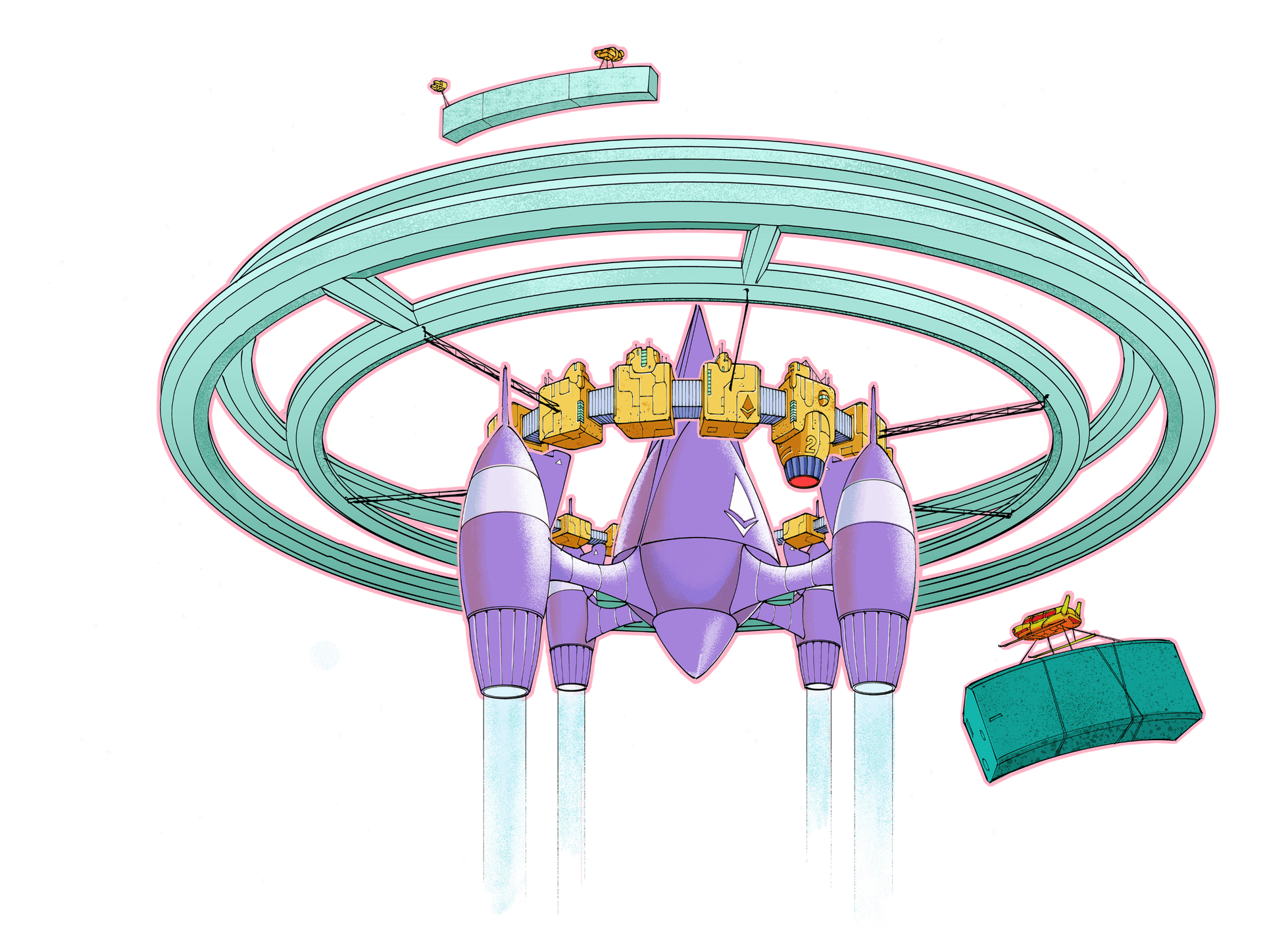
Following the transition, an Ethereum node will no longer be a monolithic entity. Instead, it will consist of two distinct layers:
- The Execution Layer: This handles the Ethereum Virtual Machine (EVM), executes smart contracts, and manages transaction data. This layer is essentially a modified version of the current PoW chain.
- The Consensus Layer: Often referred to as the Beacon Chain, this layer manages the PoS logic, coordinates validators, and ensures the network reaches agreement on the state of the blockchain.
The "Merge" refers to the moment these two layers are formally linked. At a specific block height, the PoW mining process will cease, and the execution layer will begin handing its transaction bundles to the consensus layer for validation. This separation of duties is intended to enhance the protocol’s robustness, yet it introduces a new dependency: the consensus client.
The Mathematics of Consensus and the 66% Threshold
The primary rationale for maintaining a diverse array of client software—such as Prysm, Lighthouse, Teku, Nimbus, and Lodestar—is to prevent a "consensus failure." In a distributed system like Ethereum, different software implementations of the same protocol act as a fail-safe. If one client has a bug, nodes running other clients will continue to operate normally, maintaining the integrity of the ledger.
However, the efficacy of this defense is entirely dependent on the distribution of these clients. In the context of Ethereum’s PoS mechanics, there are three critical thresholds of staking power:
- The 33% Threshold: If a client used by more than one-third of the network’s validators experiences a critical bug or goes offline, the network loses the ability to "finalize" blocks. While the chain continues to produce blocks, they are not considered permanent until the issue is resolved.
- The 50% Threshold: If a client used by a simple majority fails, the network may experience significant disturbances, including the potential for temporary forks. Automatic mechanisms would eventually penalize the faulty nodes, but the user experience would be severely impacted.
- The 66% Threshold (The Supermajority): This is the most precarious level. If a single client controls more than two-thirds of the staking power and suffers a consensus-breaking bug, it has the power to finalize an invalid chain. In this "game over" scenario, the non-buggy clients are forced to either follow the corrupted chain or initiate a manual hard fork to split the network. A manual fork of this nature would be catastrophic for the credibility and financial stability of the ecosystem.
Current data suggests that Prysm, a consensus client developed by Prysmatic Labs, hovers near or at this 66% supermajority. This concentration effectively nullifies the security benefits of having multiple client implementations.
A Chronology of Ethereum’s Path to The Merge
The journey toward The Merge has been a multi-year effort characterized by meticulous planning and incremental releases.
- July 2015: Ethereum launches Frontier, its initial PoW iteration.
- 2018–2019: Research shifts toward a "Serenity" roadmap, detailing the move to PoS.
- December 1, 2020: The Beacon Chain (the consensus layer) officially launches. This allows users to begin staking ETH, though the PoW chain continues to handle all transactions.
- Late 2021: The Altair upgrade is successfully implemented on the Beacon Chain, proving the stability of the PoS infrastructure.
- Early 2022: Testnets like Kintsugi and Kiln begin simulating The Merge, revealing the high performance of clients like Prysm but highlighting the lack of diversity.
- Mid-2022 (Target): The Merge is slated to occur on the mainnet, transitioning the execution layer to PoS.
As the timeline progressed, the convenience and early availability of certain tools led to the current imbalance. Prysm’s dominance is largely a result of its first-mover advantage. As the first prototype implementation of a beacon client, it offered more mature documentation, a refined Web UI, and better integration with early staking setups.
Supporting Data: The Institutional Contribution to Centralization
A deep dive into validator statistics reveals that the client diversity issue is not merely a result of individual "home stakers" choosing the same software. Rather, large-scale institutional staking services and centralized exchanges are the primary drivers of Prysm’s dominance.
As of early 2022, the distribution among major entities is as follows:
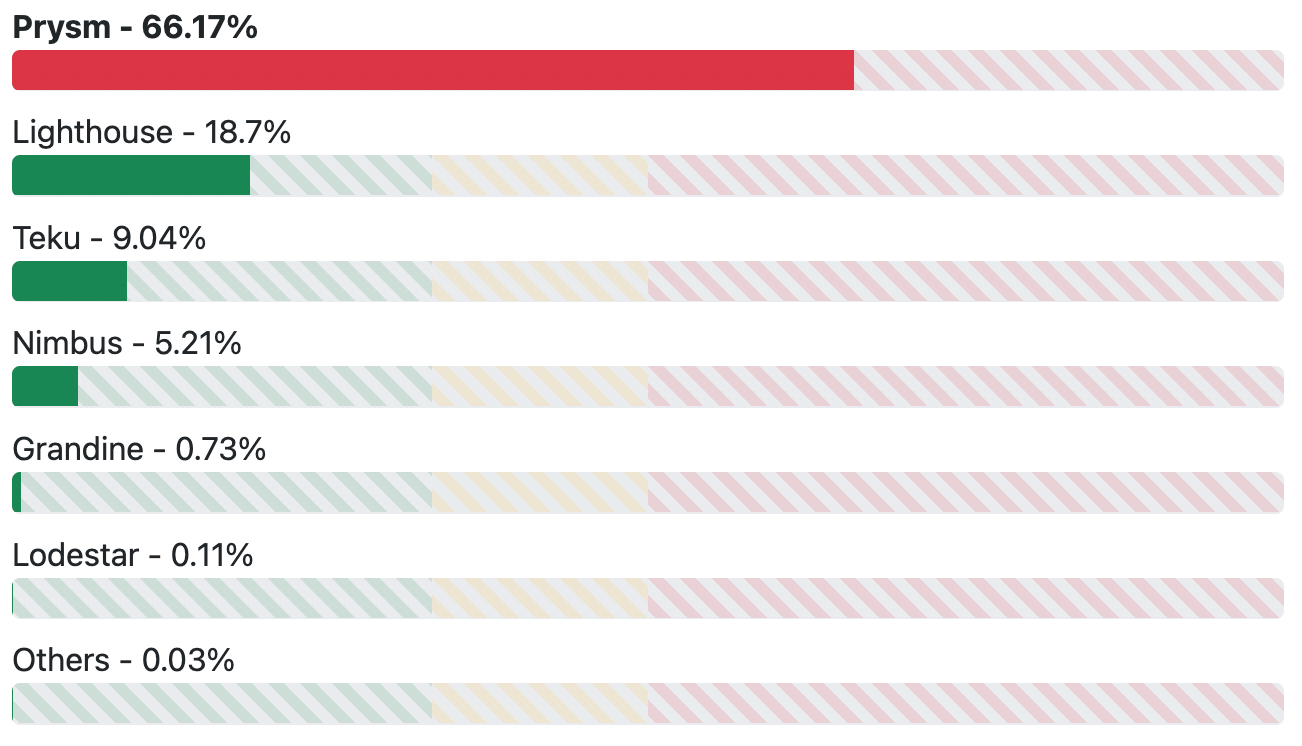
- Coinbase: Manages approximately 17.5% of all validators. Within Coinbase’s infrastructure, a staggering 92.4% run the Prysm client.
- Kraken: Controls roughly 11% of the validator set, with 94.9% of those nodes utilizing Prysm.
- Binance: Holds an 8.7% share, with 76.6% running Prysm.
- Lido: As the largest liquid staking provider with 18% of validators, Lido has a more diversified profile but still relies on Prysm for 42.8% of its operations.
When combined, these four entities represent a massive portion of the network’s consensus power. Their reliance on Prysm stems from a perceived need for stability and specific features. For instance, Coinbase Cloud has noted that Prysm was initially the only client to offer robust support for "remote signers"—a security feature that allows validator keys to be stored in isolated, high-security environments rather than on the validator node itself.
Official Responses and Mitigation Efforts
The Ethereum Foundation and core developers have been vocal about the necessity of shifting away from a Prysm supermajority. Marius van der Wijden, an Ethereum core developer, has emphasized that while the probability of a catastrophic bug is low, the "social consensus" among developers is that stakers running a majority client will not be bailed out if their software fails.
In response to these concerns, some institutions have begun to signal a shift. Kraken has stated that, following discussions with the Ethereum Foundation, it has begun rolling out new validators on the Teku client and is migrating portions of its existing infrastructure. Coinbase has also indicated that it has supported the Lighthouse client for nearly a year and worked with its developers to implement the remote signing features necessary for institutional security.
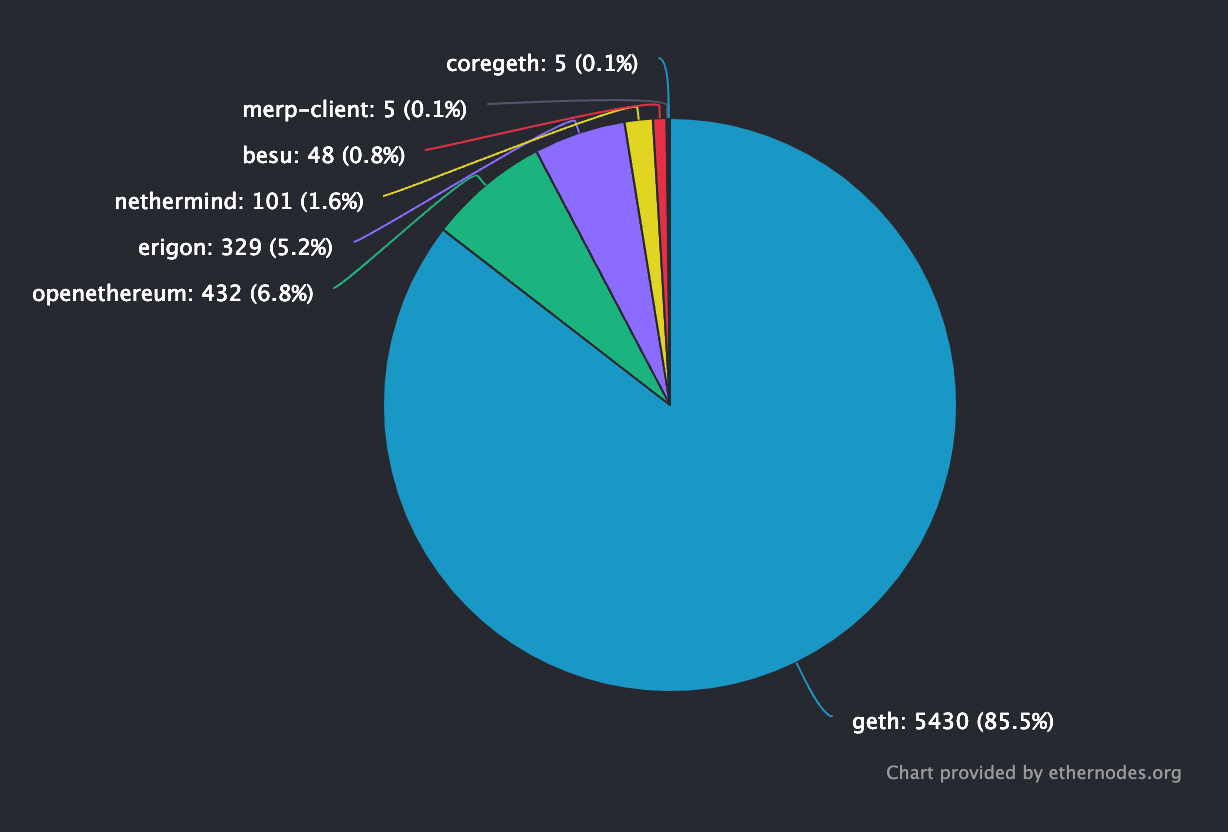
The community-led initiative "clientdiversity.org" has become a central hub for real-time data, urging node operators to switch to minority clients like Nimbus or Lodestar. Developers argue that switching clients is a low-risk procedure for most operators, requiring only a few minutes of downtime to ensure that the "slashing database" is correctly migrated to prevent double-signing penalties.
Broader Impact and Implications for the Industry
The client diversity debate touches upon the fundamental ethos of decentralization. If the world’s second-largest blockchain can be compromised by a single bug in a single piece of software, its claim to being a "world computer" is weakened.
Furthermore, the financial implications are immense. If a supermajority client fails, the "inactivity leak" mechanism in Ethereum’s PoS protocol would begin burning the ETH of the offline or faulty validators to restore the network’s ability to finalize. For an exchange like Coinbase or Kraken, this could result in the loss of millions of dollars in customer funds, leading to legal and regulatory nightmares.
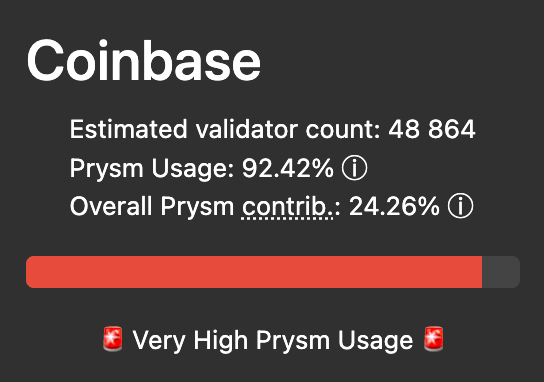
From a technical standpoint, the dominance of Geth (Go-Ethereum) on the execution layer—where it holds an 85% market share—is also a concern, though less immediate. Because the execution layer does not provide the consensus security post-Merge, a bug there is considered "recoverable" without the same risk of irreversible finality corruption that a consensus client bug poses.
Conclusion: Is The Merge Safe?
Despite the alarming statistics regarding Prysm’s 66% market share, Ethereum’s core developers remain committed to the mid-2022 timeline. The consensus among the technical leadership is that the testing infrastructure—including permanent "fuzzing" to find discrepancies between clients—is robust enough to mitigate the risk of a major failure.
The "safety" of The Merge, therefore, is not a binary state but a spectrum of risk. While the network is technically ready, the concentration of clients remains a significant "soft" vulnerability. The success of The Merge will depend not only on the code itself but on the willingness of major exchanges and staking pools to prioritize the long-term health of the network over the short-term convenience of familiar tooling. As the industry watches, the Ethereum community is learning a vital lesson: in a truly decentralized system, diversity is not just a preference—it is a mandatory security requirement.