admin
admin
Modern banking, despite its veneer of instantaneous transactions for consumers, operates on a deeply intricate and often archaic infrastructure beneath the surface. While a tap of a card or a click to buy a stock feels immediate, the underlying system orchestrating these actions is built on a complex web of coordination among numerous institutions—banks, clearinghouses, and custodians—each maintaining their own private ledgers. This fragmented approach necessitates a constant, resource-intensive process known as reconciliation, where these disparate "notebooks" are meticulously compared and aligned. The inherent inefficiencies of this system are profound, manifesting in wire transfers that can take days to settle, persistent operational risks across multi-day processes, and back-office complexities that burden the global financial industry with billions of dollars in annual costs.
In this context, blockchain technology is rapidly emerging not as a disruptive replacement for existing financial infrastructure, but as a sophisticated execution and coordination layer designed to work in conjunction with it. By introducing a shared, tamper-resistant ledger, blockchain offers a transformative solution to these deeply entrenched coordination challenges, enabling institutions to synchronize records, automate execution, and drastically reduce the need for manual reconciliation in multi-party environments. The strategic integration of blockchain promises to usher in an era of unprecedented efficiency, security, and transparency for the banking sector, fundamentally reshaping how financial transactions are processed and settled.
The Foundational Benefits of Blockchain for Financial Institutions
A blockchain, at its core, is a distributed digital ledger that records transactions in a cryptographically secure, tamper-resistant, and verifiable manner across a network of participants. In traditional banking workflows, a transaction between Bank A and Bank B involves Bank A sending a message to Bank B, which then updates its own database. Discrepancies between these records frequently necessitate manual reconciliation or intervention, leading to delays and increased costs. A blockchain-based workflow, however, allows both institutions to reference a single, shared, and continuously updated ledger state. This paradigm shift delivers four foundational benefits that are proving increasingly attractive to financial institutions:
1. Accelerated Transactions and Settlement: One of the most significant advantages blockchain offers is the potential to dramatically shorten transaction and settlement cycles. In traditional capital markets, settling a trade for equities or bonds can typically take one to two business days (T+1 or T+2), a timeframe that ties up capital and exposes counterparties to market fluctuations and credit risk. Blockchain-based settlement can reduce this cycle to near-instantaneous (T+0), particularly when combined with sophisticated Delivery-versus-Payment (DvP) and Payment-versus-Payment (PvP) workflows. This atomic settlement capability, where the exchange of assets and payment occurs simultaneously and irrevocably, materially reduces settlement risk, frees up billions in trapped liquidity, and significantly lowers the operational burden associated with multi-day post-trade processes. For instance, the DTCC (Depository Trust & Clearing Corporation) has estimated that shortening the settlement cycle to T+1 could unlock billions in capital efficiency across the U.S. markets alone.
2. Enhanced Security and Operational Resilience: The inherent design of blockchain systems utilizes advanced cryptography and distributed consensus mechanisms to protect transaction integrity across multi-party networks. Unlike centralized systems that present single points of failure, a distributed ledger ensures that no single entity controls the entire record, making it exceptionally difficult for malicious actors to alter data without detection. This distributed resilience strengthens workflows where data consistency is paramount, reducing reliance on centralized reconciliation points and mitigating the risks associated with manual controls prone to delays, errors, and operational vulnerabilities. The immutable nature of blockchain records provides an unalterable audit trail, further bolstering security.
3. Substantial Cost Reduction Through Automation: Reconciliation and manual intervention are notoriously expensive components of banking operations. Smart contracts—self-executing agreements with the terms directly written into code—enable rules-based automation across a wide array of financial processes. These include reconciliation itself, exception handling, corporate actions, and compliance checks, all areas that traditionally demand significant manual effort. By embedding "if-this-then-that" logic directly into execution workflows, banks can achieve higher straight-through processing rates, minimize human error, and realize substantial reductions in administrative and operational costs. Industry estimates suggest that automation via blockchain could reduce infrastructure costs for banks by up to 30% in certain areas.
4. Improved Transparency, Trust, and Compliance: A shared, transparent public ledger provides a single, verifiable view of transactions and asset states across all authorized participants. This inherent transparency, when coupled with privacy-preserving identity and compliance controls (such as zero-knowledge proofs or permissioned network architectures), can significantly enhance auditability and streamline regulatory reporting without exposing sensitive proprietary data. This dual capability—transparency where needed, privacy where required—strengthens trust among institutions, regulators, and clients alike, fostering a more reliable and accountable financial ecosystem. Regulators are increasingly exploring how these features can aid in real-time oversight and reduce the reporting burden.
The Imperative for Blockchain Adoption: Addressing Legacy Constraints
The current wave of blockchain exploration by banks is a direct response to long-standing infrastructure constraints. While customer-facing digital experiences have evolved rapidly, much of the underlying banking technology stack still relies on antiquated batch processing, message-based coordination (like SWIFT messaging), and the aforementioned manual reconciliation. These legacy systems, often decades old, are costly to maintain, difficult to upgrade, and ill-suited for the demands of a hyper-connected, real-time global economy.
A shared, programmable state layer offered by blockchain makes it possible to reduce operational friction, accelerate settlement, and introduce automation without necessitating the wholesale replacement of existing systems. This incremental, standards-based approach allows banks to create production-grade blockchain systems that work alongside traditional infrastructure, delivering measurable efficiency gains while preserving crucial regulatory compliance and operational continuity. This pragmatic approach is key to overcoming the inherent conservatism of the financial sector and facilitating broader adoption.
Key Blockchain Use Cases Revolutionizing Banking Operations
The practical applications of blockchain in banking extend across numerous critical operational domains:
1. Payments and Money Transfers: Cross-border payments are a prime example of an area ripe for blockchain-driven transformation. The current system often involves fragmented messaging systems, multiple intermediary banks (correspondent banking), and delayed finality, each introducing latency, high costs (e.g., foreign exchange fees, intermediary bank charges), and significant reconciliation overhead. Blockchain-enabled workflows aim to vastly improve coordination and settlement efficiency. The maturation of stablecoins, tokenized deposits, and central bank digital currencies (CBDCs) alongside traditional payment rails is creating a powerful synergy. Institutions are actively exploring how existing messaging standards, such as ISO 20022, can be connected to blockchain environments to support programmable payments, enabling faster, cheaper, and more transparent international transfers without disrupting core payment infrastructure. The World Bank estimates that global remittance fees alone cost billions annually, a figure that blockchain could significantly reduce.
2. Clearing and Settlement: This domain is arguably one of the most operationally complex in finance, requiring precise data synchronization across custodians, clearinghouses, broker-dealers, and asset servicers. Today, this coordination relies heavily on message-based confirmations and extensive post-trade reconciliation across siloed systems. Blockchain can serve as a common coordination layer for post-trade activity, drastically reducing reconciliation overhead and providing more consistent, real-time access to verified records. As assets become tokenized (e.g., tokenized securities), standardized reference data and coordinated workflows across both traditional and blockchain environments become critical to achieving faster, lower-risk settlement, unlocking capital, and reducing counterparty risk.
3. Trade Finance: Trade finance remains a highly document-heavy and coordination-intensive sector, involving a multitude of parties including banks, logistics providers, insurers, and customs authorities. The reliance on disconnected systems and manual documentation introduces endemic delays, disputes, and elevated fraud risk throughout the entire trade lifecycle. Blockchain-based workflows can synchronize key trade events—such as shipment status updates, document issuance (e.g., bills of lading, letters of credit), and ownership transfers—across all participants in near real time. By maintaining a shared, immutable record of these events, institutions can dramatically reduce paperwork, accelerate settlement, and improve trust among all parties, all while preserving existing operational roles and responsibilities. The International Chamber of Commerce estimates a $1.7 trillion gap in global trade finance, partly due to the inefficiencies that blockchain can address.
4. Identity Verification and Compliance (KYC/AML): Identity and compliance (Know Your Customer/Anti-Money Laundering) are foundational to banking but are currently costly and repetitive due to duplicated verification processes across institutions. Customers are frequently required to resubmit sensitive documentation multiple times, while banks independently perform similar checks on the same information. Blockchain-based identity solutions, particularly those leveraging verifiable credentials, empower individuals and institutions to prove specific attributes (e.g., KYC status, age, eligibility) without repeatedly sharing underlying personal data. This approach significantly reduces duplication in compliance workflows, supports jurisdiction-specific regulatory requirements, and strengthens privacy protections, leading to more efficient and secure identity management across the financial sector.
Real-World Examples: Blockchain’s Growing Footprint in Banking
Leading banks and market infrastructures are actively integrating blockchain platforms that directly connect with their existing systems, standards, and regulatory frameworks, moving beyond pilot programs into production environments. These initiatives underscore a pragmatic adoption strategy that preserves critical infrastructure and controls. Chainlink, a decentralized oracle network, has emerged as a key enabler across many of these use cases, powering essential data, interoperability, compliance, and privacy solutions.
Swift Connectivity and Cross-Chain Settlement: A significant collaboration between Chainlink and Swift (Society for Worldwide Interbank Financial Telecommunication) has focused on enabling financial institutions to connect to multiple public and private blockchain networks using existing Swift infrastructure and messaging standards. Leveraging Chainlink’s Cross-Chain Interoperability Protocol (CCIP), these initiatives demonstrate how tokenized asset settlement workflows can be coordinated alongside traditional payment rails without requiring banks to overhaul their core messaging systems. Under the Monetary Authority of Singapore’s Project Guardian, Swift, UBS Asset Management, and Chainlink successfully demonstrated the issuance and settlement of tokenized assets using existing fiat payment infrastructure, charting a practical, standards-based path to institutional adoption. This integration is crucial, as Swift processes trillions of dollars in transactions daily across thousands of financial institutions.
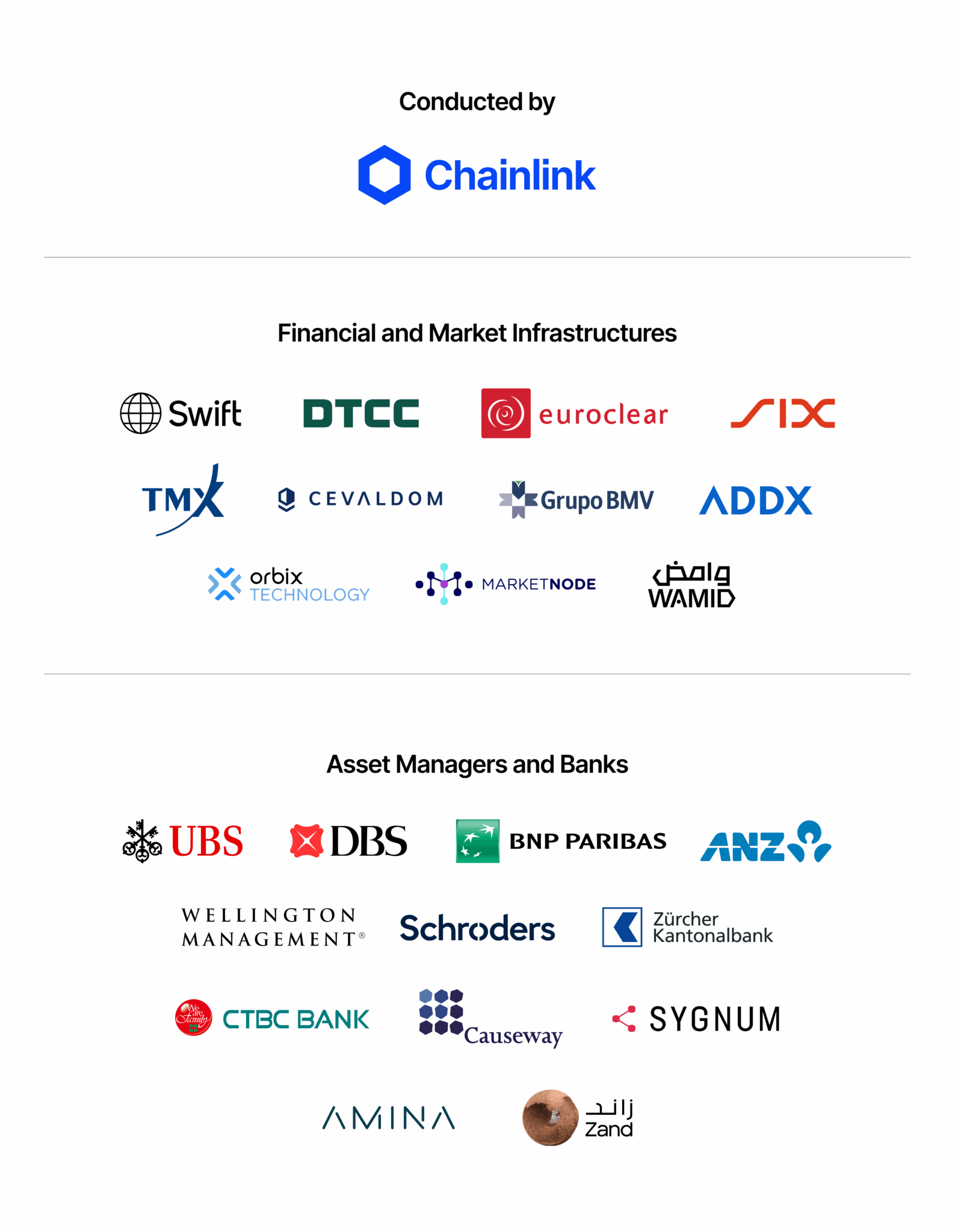
Standardizing Corporate Actions Across Global Markets: Chainlink has powered a global industry initiative involving 24 financial institutions and market infrastructures, including prominent names like Swift, DTCC, Euroclear, UBS, DBS Bank, ANZ, BNP Paribas, Wellington Management, and Schroders. This initiative directly addresses the longstanding complexity and estimated $58 billion annual cost associated with corporate actions processing (e.g., dividends, stock splits, mergers). By combining oracle networks and blockchains with structured data extraction and validation, this work aims to transform fragmented, manual corporate actions workflows into standardized, near-real-time processes. The expected outcomes include reduced operational costs, lower error rates, and significantly less reconciliation overhead across diverse jurisdictions.
Tokenized Fund and Digital Asset Settlement: Chainlink has been instrumental in multiple major institutional initiatives involving tokenized assets and stablecoins. Collaborations with Kinexys by J.P. Morgan, Ondo Finance, and other market participants have successfully demonstrated atomic Delivery-versus-Payment (DvP) settlement workflows. These mechanisms coordinate both the asset and payment legs of a transaction to reduce settlement risk and operational complexity. Such demonstrations highlight how tokenized assets can settle with greater certainty and efficiency when execution and coordination occur within a shared, programmable environment, offering a glimpse into the future of capital markets.
Cross-Border Compliance and Identity Workflows: In Asia, Chainlink has facilitated compliant cross-chain settlement under initiatives such as the Hong Kong Monetary Authority’s e-HKD+ program. In these projects, institutions like ANZ Bank, China AMC, and Fidelity International utilized Chainlink infrastructure to verify investor eligibility, enforce jurisdiction-specific controls, and execute tokenized asset transactions across borders. These workflows showcase how blockchain-based settlement can meet stringent regulatory requirements while preserving privacy and supporting complex cross-jurisdictional operations, which is vital for global financial hubs.
Integration With Institutional Messaging and Transfer Agency Systems: The Chainlink Runtime Environment (CRE) is designed to enable financial institutions to initiate on-chain fund workflows directly from existing enterprise infrastructure, including ISO 20022 messages transmitted via Swift. In collaboration with UBS Tokenize, Chainlink demonstrated how subscription and redemption requests for tokenized funds could be orchestrated on-chain through standardized transfer agency workflows without necessitating the replacement of core banking systems or operational processes. This capability underscores the "integration, not replacement" philosophy that is driving much of the institutional blockchain adoption.
Challenges and Considerations in Blockchain Adoption
Despite the significant progress and evident benefits, blockchain adoption in banking faces several notable challenges as the technology continues to evolve:
1. Regulatory Clarity and Legal Frameworks: The rapidly evolving nature of blockchain technology often outpaces existing regulatory frameworks. Banks operate in highly regulated environments, and uncertainty regarding legal recognition of tokenized assets, smart contracts, and cross-border data flows remains a significant hurdle. Regulators globally are actively working to provide guidance, but a harmonized international approach is still nascent.
2. Scalability and Performance: While new blockchain architectures are emerging, some traditional public blockchains may not yet meet the high transaction throughput and low latency requirements of global financial markets, which process millions of transactions per second. Private or permissioned blockchains and Layer 2 solutions are being developed to address these performance demands.
3. Interoperability Between Disparate Blockchains and Legacy Systems: The financial ecosystem is vast and comprises numerous different blockchain networks and countless legacy systems. Ensuring seamless and secure interoperability between these disparate systems is crucial for widespread adoption. This includes the ability to exchange data and value reliably across different blockchain protocols and between blockchains and off-chain data sources.
4. Data Privacy and Confidentiality: While transparency is a core blockchain feature, banks handle highly sensitive customer and proprietary data that must remain confidential. Solutions like zero-knowledge proofs, confidential computing, and carefully designed permissioned ledgers are essential to balance transparency with privacy requirements.
5. Governance and Consortium Management: Implementing shared ledgers requires robust governance models, especially in consortium blockchains involving multiple competing institutions. Establishing clear rules for network participation, upgrades, dispute resolution, and data management is complex but critical for success.
6. Integration Complexity with Existing IT Infrastructure: Integrating new blockchain solutions with decades-old, deeply entrenched legacy IT systems can be a complex, costly, and time-consuming endeavor. This often requires significant architectural planning and phased implementation.
These realities explain why most institutional initiatives prioritize standards-based integration, incremental deployment, and controlled automation—a pragmatic approach to navigate the complexities of this technological transition.
Chainlink’s Pivotal Role in Accelerating Blockchain Adoption in Banking
Modern banking’s journey towards blockchain adoption demands more than just token issuance. It requires trusted data, secure cross-network coordination, and seamless integration with existing institutional workflows and regulatory compliance. The Chainlink platform addresses these critical requirements, enabling banks to operationalize blockchain-based processes in production environments by providing:
- Trusted Data Oracles: Chainlink’s decentralized oracle networks securely connect real-world data, events, and computations from traditional systems to blockchain environments. This is vital for smart contracts that need external information to execute reliably, such as market prices, interest rates, or corporate actions data.
- Secure Cross-Network Interoperability: Through its Cross-Chain Interoperability Protocol (CCIP), Chainlink provides a robust, secure, and future-proof standard for financial institutions to send data and value across disparate public and private blockchain networks, facilitating the seamless movement of tokenized assets and payments.
- Compliance and Privacy Solutions: Chainlink offers tools and capabilities for integrating verifiable credentials, confidential computing, and other privacy-preserving technologies directly into blockchain workflows, ensuring that institutional operations meet stringent regulatory requirements without compromising sensitive data.
- Seamless Integration with Legacy Systems: The Chainlink Runtime Environment (CRE) allows financial institutions to interact with blockchain networks and initiate on-chain workflows directly from their existing enterprise infrastructure, including ISO 20022 messages and traditional messaging systems, without requiring a complete overhaul.
This comprehensive approach allows banks to modernize and integrate blockchain workflows that add tangible value while maintaining the reliability, security, and stringent controls required by global capital markets. By enabling standards-based connectivity between legacy systems and innovative blockchain environments, Chainlink is uniquely positioned to empower financial institutions to innovate across both traditional and emerging on-chain finance paradigms, paving the way for a more efficient, secure, and interconnected global financial system. The convergence of established financial institutions and cutting-edge blockchain technology, facilitated by platforms like Chainlink, is not just a trend but a fundamental evolution poised to redefine the future of banking.