admin
admin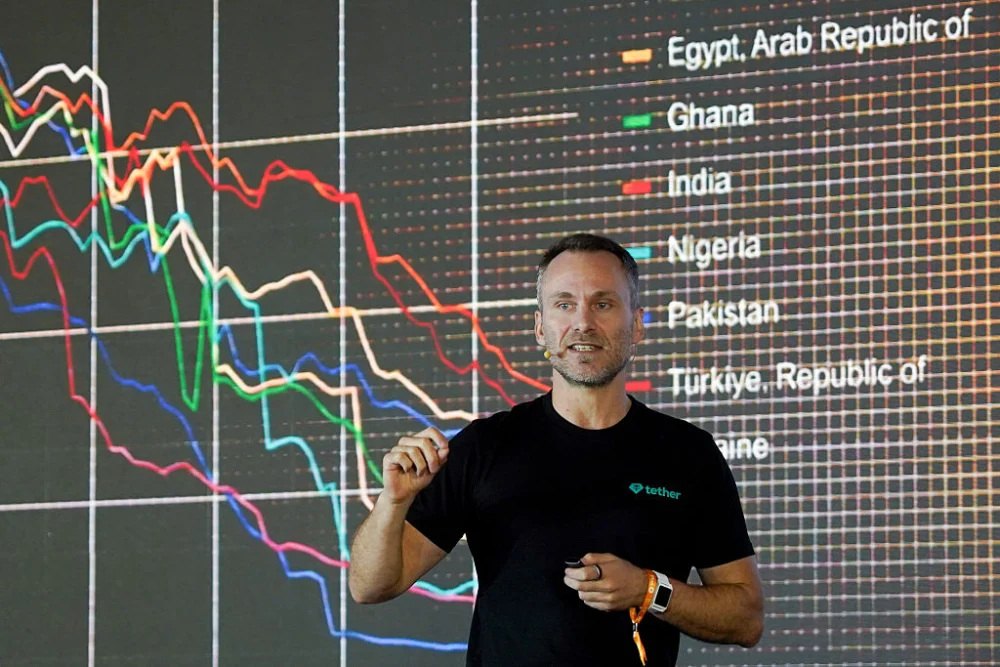
Tether, the issuer of the world’s largest stablecoin by market capitalization, has initiated a high-profile media campaign led by CEO Paolo Ardoino. This strategic communications push, featuring major engagements with Fortune, Bloomberg, Reuters, and TechCrunch, marks a significant pivot in the company’s public relations strategy. The timing coincides with the launch of USAT, a federally regulated, dollar-backed stablecoin issued through Anchorage Digital Bank. Designed to comply with emerging U.S. regulatory frameworks, USAT represents Tether’s first direct attempt to challenge the domestic dominance of Circle’s USDC and new entrants such as Fidelity Investments’ FIDD token.
The emergence of USAT signals a departure from Tether’s historical avoidance of the United States. For much of its decade-long history, the company operated primarily from offshore jurisdictions, facing intense scrutiny from the Department of Justice (DOJ) and the Commodity Futures Trading Commission (CFTC). Critics and legacy media outlets frequently characterized the firm as opaque; a 2025 report by The Economist famously labeled the flagship USDT token a "money launderer’s dream." However, Ardoino’s current outreach suggests a transformation from an embattled crypto outlier to a mainstream financial powerhouse seeking deep integration with the American financial and regulatory systems.
The Strategic Launch of USAT and the Competitive Landscape
The introduction of USAT is a calculated move to capture institutional market share within the United States. Unlike USDT, which has a global circulation of approximately $187 billion but remains outside the perimeter of new U.S. federal stablecoin requirements, USAT is structured to meet specific compliance standards. By partnering with Anchorage Digital Bank, a federally chartered crypto bank, Tether is positioning itself to compete in a rapidly crowding field.
This week alone, Fidelity Investments launched its own stablecoin, joining a race that already includes established financial giants like JPMorgan Chase and PayPal. The competition is no longer limited to crypto-native firms; it now involves systemic financial institutions. Ardoino’s media blitz serves to remind the market that despite the new competition, Tether remains the incumbent leader, boasting a user base of 536 million people—a figure growing by approximately 30 million every quarter.
A History of Resilience: From TerraLuna to Silicon Valley Bank
To understand Tether’s current positioning, it is necessary to examine its performance during recent periods of market volatility. Ardoino frequently points to the collapse of the TerraLuna ecosystem in May 2022 as a defining moment for the company. During the ensuing market panic, Tether processed $7 billion in redemptions within 48 hours and a total of $20 billion over 20 days. According to Ardoino, this represented roughly 25% of the company’s reserves at the time, a "bank run" scenario that he claims few traditional financial institutions could have survived.
This track record of liquidity is often contrasted with the 2023 banking crisis, specifically the collapse of Silicon Valley Bank (SVB). When SVB failed, Tether’s primary competitor, Circle, experienced a brief de-pegging of its USDC token after revealing a $3 billion exposure to the insolvent bank. Tether, which had shifted its reserves away from vulnerable regional banks toward U.S. Treasury bills and secured custody at Cantor Fitzgerald, remained stable throughout the crisis. This period solidified Ardoino’s argument that Tether’s reserve management is more conservative than the fractional-reserve models utilized by traditional commercial banks.
Financial Performance and Reserve Management
Tether’s financial trajectory has reached unprecedented levels of profitability. In 2025, the company reported a net profit of $15 billion, largely driven by the yields generated from its massive holdings of U.S. Treasury bills. These reserves are managed in collaboration with Cantor Fitzgerald, the Wall Street firm formerly led by Howard Lutnick, who currently serves as the U.S. Commerce Secretary. Lutnick has been a vocal proponent of Tether, providing a bridge between the crypto firm and the highest levels of the U.S. government.
The company currently maintains approximately $30 billion in excess reserves, providing a buffer that Ardoino claims makes the token "safer than a bank." Unlike traditional savings accounts, Tether does not share the interest earned on its reserves with token holders. While this has drawn criticism, Ardoino defends the model by highlighting the primary utility of the token for users in hyperinflationary economies. In nations like Argentina and Turkey, where local currencies have lost over 80% to 90% of their value against the dollar in the last five years, the preservation of capital is more critical than a 4% annual yield.
Law Enforcement Collaboration and Illicit Finance
Addressing the long-standing allegations regarding the use of USDT in criminal activity remains a priority for Ardoino. The CEO has shifted the narrative from defensive to proactive, highlighting Tether’s collaboration with nearly 300 law enforcement agencies across more than 60 countries, including the FBI and the Secret Service.
Tether reports having frozen $3.5 billion in tokens associated with illicit activity to date. A significant portion of these actions involved "pig-butchering" scams—a sophisticated form of investment fraud. In one notable instance in 2023, Tether proactively identified and froze $225 million linked to such a syndicate. Ardoino argues that the transparency of the blockchain allows for more effective monitoring than the traditional cash-based financial system. "If there are cash pallets roaming around the world, U.S. law enforcement can hardly do anything about it," Ardoino stated. "But with USDT, we can quickly freeze the funds."
Despite these efforts, skepticism remains. S&P Global Ratings recently assessed USDT’s stability as "weak," a rating Ardoino dismissed by citing the agency’s failure to predict the 2008 subprime mortgage crisis.
Diversification: Gold, AI, and Sovereign-Style Investments
Under Ardoino’s leadership, Tether is evolving into an entity that resembles a sovereign wealth fund more than a simple payment processor. The company has aggressively diversified its balance sheet into physical assets and emerging technologies.
The Global Gold Strategy
Tether Gold (XAUT), a token backed by physical bullion, currently has $2.6 billion in circulation. However, the company’s total gold exposure is much larger. Tether reportedly holds 140 tons of gold, valued at approximately $24 billion, making it one of the largest private holders of the metal globally. The company continues to acquire gold at a rate of one to two tons per week, positioning itself as a "digital central bank" for those seeking alternatives to fiat currency.
Decentralized AI: The Qvac Platform
Perhaps the most ambitious of Tether’s new ventures is its push into Artificial Intelligence. The company recently launched Qvac, a decentralized AI platform named after a concept in Isaac Asimov’s science fiction. Ardoino envisions a future where AI models run locally on smartphones in emerging markets, bypassing the subscription-based models of centralized providers like OpenAI or Google. By leveraging Tether’s massive user base in Africa and South America, Ardoino aims to provide AI access to those "left behind" by the traditional tech ecosystem.
Strategic Venture Capital
Tether’s investment portfolio now spans several critical industries:
- Robotics: A $1 billion commitment to the German AI firm Neura.
- Infrastructure: Significant stakes in satellite communications and data centers.
- Agriculture: Investments in land and cattle to ensure long-term stability.
- Media: A $775 million investment in the social media platform Rumble.
Ardoino describes these seemingly disparate investments as part of an "interlocking system" designed to ensure Tether’s longevity and social impact.
Regulatory Outlook and the CLARITY Act
The future of Tether’s business model in the United States may be shaped by the pending CLARITY Act. This legislation, currently moving through Congress, seeks to establish a federal framework for stablecoins while prohibiting issuers from paying interest to holders.
For Tether, the passage of the CLARITY Act would be a double-edged sword. On one hand, it would codify the company’s existing non-interest-bearing model, potentially neutralizing competitors who rely on yield-sharing to attract users. On the other hand, it would bring Tether under stricter federal oversight, requiring even greater transparency regarding its reserve composition.
Ardoino remains optimistic about the political climate, suggesting that financial inclusion is a bipartisan issue. He argues that by bringing hundreds of millions of people into the dollar-denominated ecosystem, Tether serves the strategic interests of the United States, regardless of which political party is in power.
Analysis of Global Implications
The transformation of Tether from an offshore stablecoin provider to a global infrastructure giant has profound implications for the international financial order. By providing a digital dollar that operates outside the traditional SWIFT banking system, Tether has created a parallel financial rails that is particularly attractive in the "Global South."
However, this growth also presents challenges for monetary sovereignty. As Tether becomes a major holder of U.S. Treasuries and gold, its systemic importance grows. The "media blitz" currently underway is not merely a marketing exercise; it is an attempt to secure a "seat at the table" as global regulators move to formalize the digital asset economy. Whether Tether can maintain its dominance while navigating the transition to a regulated environment will be the defining theme of Ardoino’s tenure.
As the company prepares for its presence at major industry events like TechCrunch Disrupt in San Francisco, the focus will remain on whether its new USAT product can successfully bridge the gap between the unregulated "Wild West" of crypto’s past and the highly supervised future of digital finance.