admin
The Architecture of Agentic Finance
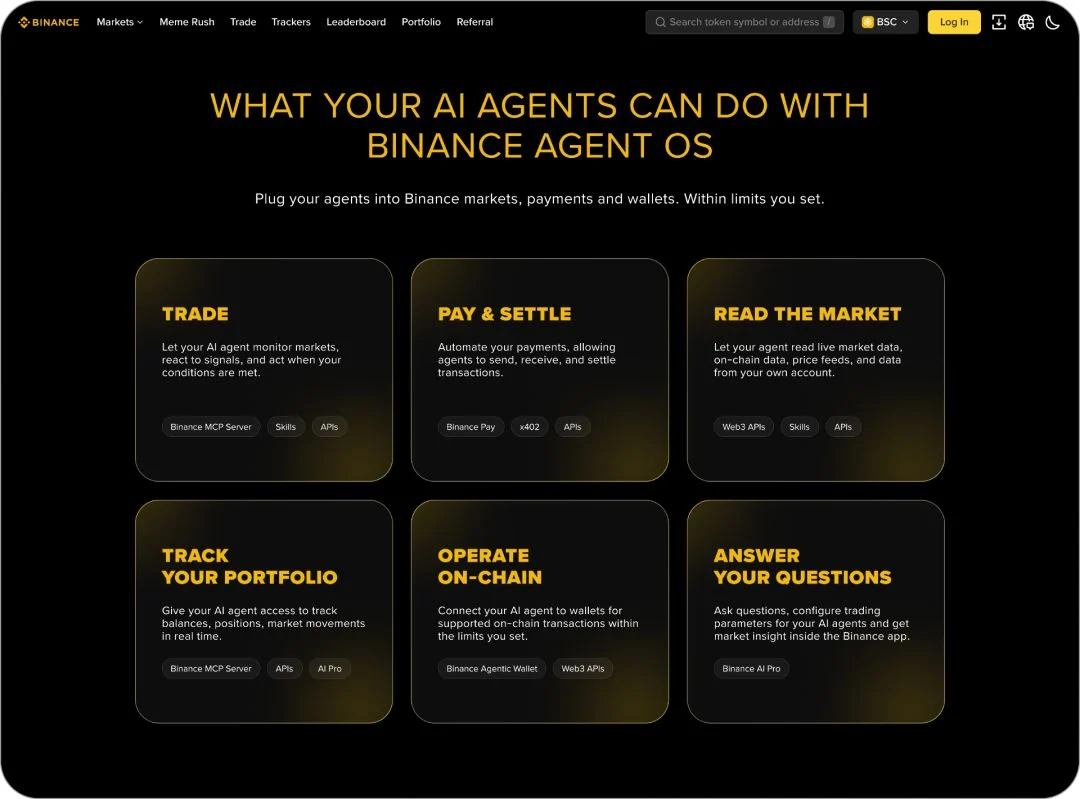
At its core, Agent OS serves as a comprehensive development environment and execution layer that connects AI applications to Binance’s deep financial liquidity and infrastructure. The platform is not a singular AI tool but rather an "Operating System" that facilitates the integration of various external AI models and developer tools into the Binance ecosystem. Central to this integration is the support for the Model Context Protocol (MCP), an open standard that allows AI models to seamlessly access data sources and tools without custom, one-off integrations.
The platform consolidates several of Binance’s existing technological pillars while introducing new functionalities. Key components include the Binance APIs for market data and execution, the Binance Wallet Agentic Hub for on-chain interactions, and the Binance Skill Hub, which provides a library of pre-defined functions that agents can utilize. Furthermore, the integration includes the Binance x402 transaction verification and payment facilitator API, a specialized protocol designed to streamline micro-payments and settlements for autonomous agents.
Beyond internal tools, Agent OS is designed for compatibility with the world’s leading AI development frameworks. Developers can connect agents powered by OpenAI’s ChatGPT and Codex, Anthropic’s Claude Code, and the AI-native code editor Cursor. This interoperability ensures that the most sophisticated reasoning engines currently available can be granted the "hands" necessary to move money, view account balances, and react to market volatility in real-time.
A New Paradigm: From Chatbots to Action-Oriented Agents
The launch of Agent OS represents a significant milestone in the evolution of artificial intelligence. For the past several years, the "AI Summer" has been defined largely by Large Language Models (LLMs) acting as sophisticated chatbots—answering questions, writing code, and summarizing documents. However, the industry is now entering the era of "Agentic AI," where the focus shifts from generating text to executing tasks.
In the context of crypto-economics, this means moving beyond simple "if-then" trading bots. An AI agent powered by Agent OS can ingest a diverse array of inputs, such as social media sentiment, global macroeconomic news, and technical indicators. It can then formulate a hypothesis, determine a risk-adjusted position size, and execute the trade across spot or futures markets without human intervention. This autonomy brings both unprecedented efficiency and a new set of risks regarding financial oversight and security.
The Security Framework: Sandboxing and User Responsibility
Recognizing the inherent risks of granting autonomous software control over financial assets, Binance has implemented a security model centered on granular user control and "sandboxing." Jeff Li, Vice President of Product at Binance, emphasized in a recent briefing that the platform is designed to put the ultimate authority in the hands of the human account holder rather than the AI agent.
The primary mechanism for this protection is the use of dedicated "subaccounts." Instead of granting an AI agent access to their primary holdings, users can create isolated subaccounts specifically for agentic activity. These subaccounts act as a firewall; by default, withdrawal capabilities are blocked, ensuring that even if an agent is compromised or malfunctions, it cannot drain the user’s entire portfolio or move funds to external addresses.
Users are also required to configure specific permissions for each agent. These permissions can be narrowed down to specific trading pairs (e.g., BTC/USDT), specific markets (Spot vs. Futures), and specific order types. Additionally, the platform allows for a "Human-in-the-Loop" configuration, where the AI agent can suggest trades that require a manual "click to approve" from the user, or a fully autonomous mode where the agent operates within the predefined limits of the subaccount balance.
The Challenge of the "Black Box" and AI Manipulation
One of the most complex challenges facing the adoption of Agent OS is the "reasoning gap." Because the AI’s cognitive processes—the logic it uses to decide to buy or sell—occur on the user’s local machine or within a third-party cloud (like OpenAI or Anthropic), Binance’s systems are blind to the "why" behind a trade.
"We really cannot see the reasoning of what the user’s action is," Li stated, noting that Binance only sees the resulting API call to execute a trade. This lack of visibility means that if an AI agent is influenced by "prompt injection"—a technique where malicious actors trick an AI into following unauthorized instructions through hidden text or manipulated data inputs—the exchange may not be able to distinguish the malicious trade from a legitimate one until after the fact.
To combat this, Binance relies on its existing suite of risk-control and anti-money-laundering (AML) protocols. Every transaction initiated by an agent through Agent OS is subjected to the same real-time monitoring and fraud detection as a human-initiated trade. However, the exchange maintains that the responsibility for the agent’s behavior rests with the user who authorized its access.
Chronology of the Agentic AI Race in Crypto
Binance’s entry into the AI agent space follows a series of moves by other major players in the industry, highlighting a broader trend toward the "agentization" of decentralized finance.
- March 2024: Kraken launched its open-source command-line tool equipped with an MCP server, allowing developers to build agents that could execute spot and futures trades via a standardized interface.
- June 2024: Coinbase introduced "Coinbase for Agents," a platform specifically designed to give AI agents a "bank account" (via the Coinbase SDK) to trade, send USDC, and interact with the Base layer-2 network.
- Late 2024: OKX enabled "Agent Trade Kit," focusing on bringing open-source MCP toolkits to its user base to foster a developer ecosystem around autonomous trading strategies.
- Present: Binance launches Agent OS, aiming to leverage its massive 300-million-user reach and diverse product suite (including payments and DeFi) to become the dominant infrastructure for AI-led finance.
Transactional Limits and the Agentic Wallet
While Binance does not impose a hard cap on the volume of trades an agent can execute within a subaccount—the limit is effectively whatever capital the user has deposited—it has established strict daily limits for other types of autonomous financial activity. These limits are particularly relevant for the "Agentic Wallet," which allows agents to interact with decentralized finance (DeFi) protocols and settle payments.

The current daily limits for AI agents are structured as follows:
- Token Swaps: Capped at $50,000 per day.
- DeFi Transactions: A default limit of $100,000 per day.
- x402 Payments: Limited to $20 per day, intended for micro-services and API fee settlements.
These caps are designed to prevent "flash crashes" or massive capital outflows in the event of an algorithmic loop or a security breach. As the technology matures and the exchange gains more data on agent behavior, these limits may be adjusted.
Broader Market Implications and Future Outlook
The launch of Agent OS could redefine the role of the retail trader. Historically, sophisticated algorithmic trading was the domain of hedge funds and institutional market makers with the resources to build proprietary execution engines. By democratizing access to agentic infrastructure, Binance is providing retail users with the tools to compete on a more level playing field.
However, the "AI-ification" of the markets also raises concerns about market stability. If a significant portion of trading volume becomes driven by similar AI models reacting to the same news events, the risk of "herding" behavior and correlated volatility increases. Furthermore, the regulatory landscape for AI agents in finance remains largely unwritten. Regulators in the US, EU, and Asia are currently grappling with how to assign legal liability when an autonomous agent violates securities laws or engages in market manipulation.
For Binance, Agent OS is more than just a trading tool; it is a strategic bet on the future of the internet. As AI agents become the primary way users interact with the digital world—performing tasks like booking travel, managing schedules, and shopping—it is logical that these agents will also need the ability to manage their creator’s wealth. Agent OS positions Binance as the foundational financial layer for this new autonomous economy, ensuring that when the AI agents of the future need to trade or pay, they do so through the Binance ecosystem.